When AutoCAD's native CONVTOSOLID command fails on a polyface mesh, the reason is almost always the same: the mesh is non-manifold. Non-manifold geometry - meshes with open boundaries, holes, or edges shared by more than two faces - cannot be converted to a closed 3D solid by AutoCAD's standard tools.
This guide shows how to fix a non-manifold polyface mesh and convert it to a clean, watertight 3D solid in AutoCAD in four steps using Automesher Application, which automatically detects and fills mesh holes before attempting the conversion.
What Is a Non-Manifold Mesh and Why Does It Matter?
A manifold mesh is a mesh where every edge is shared by exactly two faces, every vertex has a well-defined surface neighborhood, and the mesh forms a completely closed surface with no holes or gaps. Think of it as a mesh you could fill with water - a watertight container.
A non-manifold mesh fails one or more of these conditions. Common non-manifold issues include open boundaries (edges with only one adjacent face), holes and gaps in the surface, T-junctions (three or more faces sharing one edge), and isolated vertices not connected to any face. These issues arise frequently in meshes imported from STL files, 3D scan data, SketchUp models, or OBJ files assembled from multiple parts.
AutoCAD's CONVTOSOLID command requires a perfectly manifold input. Any non-manifold condition causes it to fail silently - which is why the AmConvertMesh command from Automesher with its Fill Holes option is the practical alternative for real-world mesh data.
How to Convert Non-Manifold Mesh to Watertight Solid
🚀 Run AmConvertMesh Command
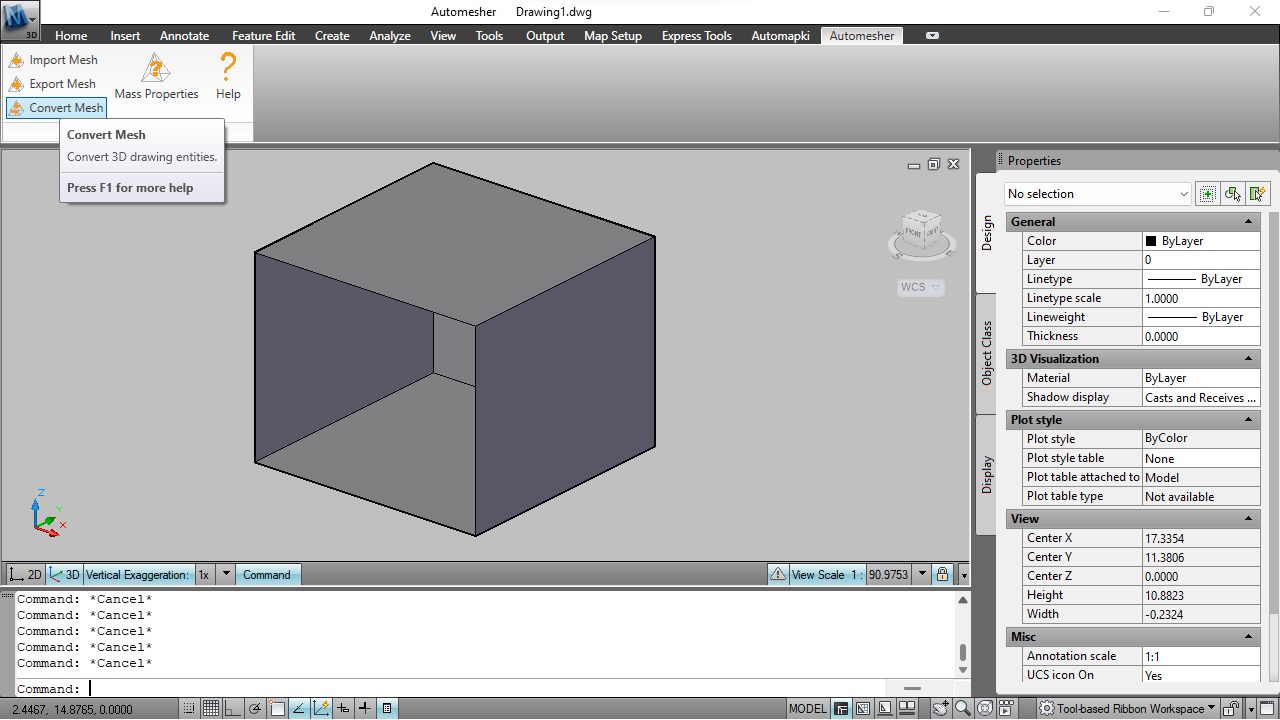
Install Automesher Application and restart AutoCAD to autoload the plugin. Open your DWG file containing the polyface mesh. Type AmConvertMesh in the AutoCAD command line and press Enter, or click the Convert Mesh button in the Automesher ribbon.
🔍 Select the Non-Manifold Mesh
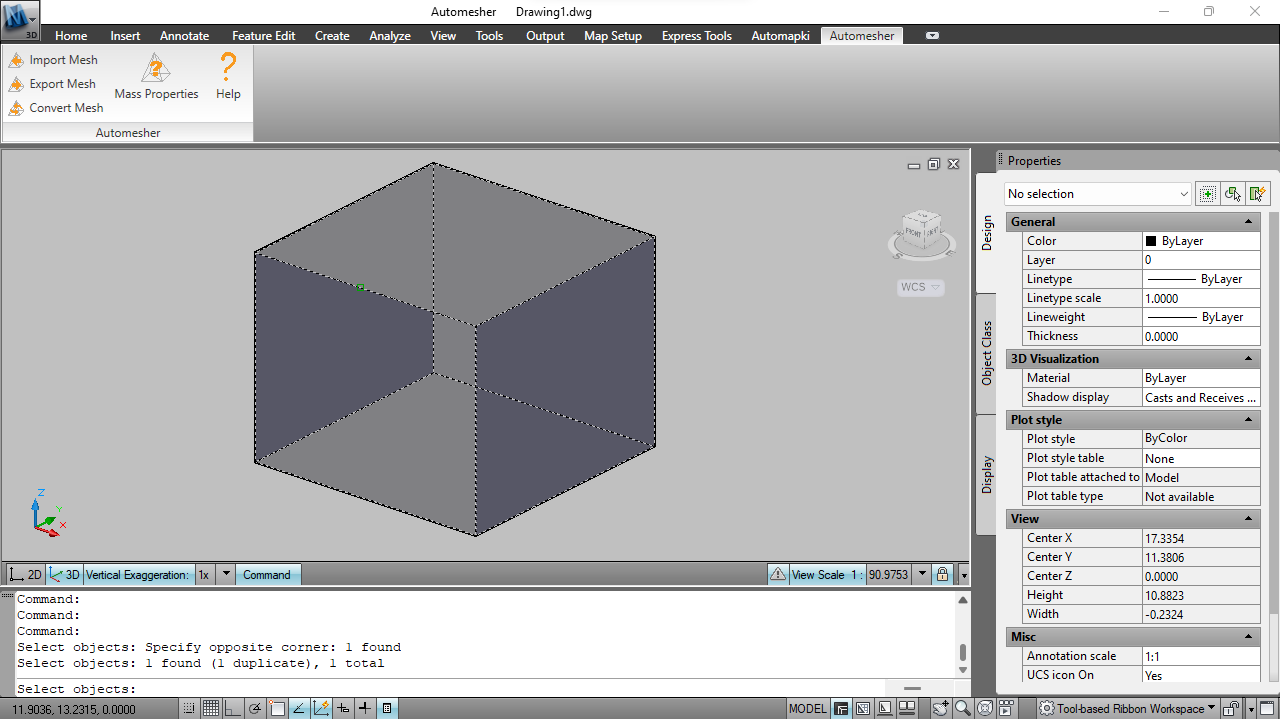
Select the polyface mesh object you want to convert using standard AutoCAD selection tools - click to select individually, or use a window/crossing selection for multiple objects. Press Enter to confirm the selection and open the conversion dialog.
✅ Enable Fill Holes and Configure Options
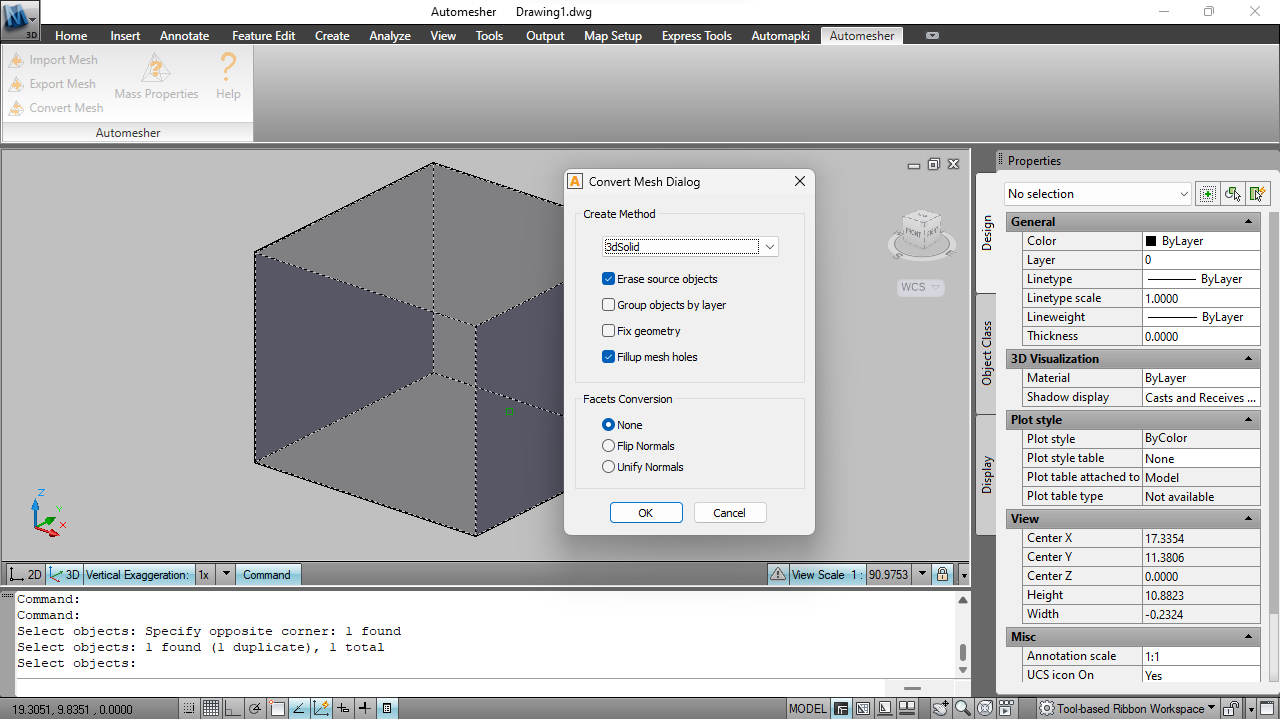
In the conversion settings dialog, enable the following options for non-manifold mesh conversion:
- Convert to 3dSolid - produces a true AutoCAD 3D solid body (ACIS-based) that supports Boolean operations, section planes, and engineering analysis
- Fill Holes - automatically detects open boundaries and gaps in the mesh and closes them before conversion. This is the critical option for non-manifold meshes - without it, the conversion will fail or produce an unclosed body
- Fix Geometry - repairs non-manifold edges, degenerate faces, and winding order errors that would prevent a valid solid from being generated
- Erase Source Entities - removes the original polyface mesh after conversion to avoid duplicate geometry in the same location
Click OK to start the conversion.
🧊 Verify the Watertight 3D Solid
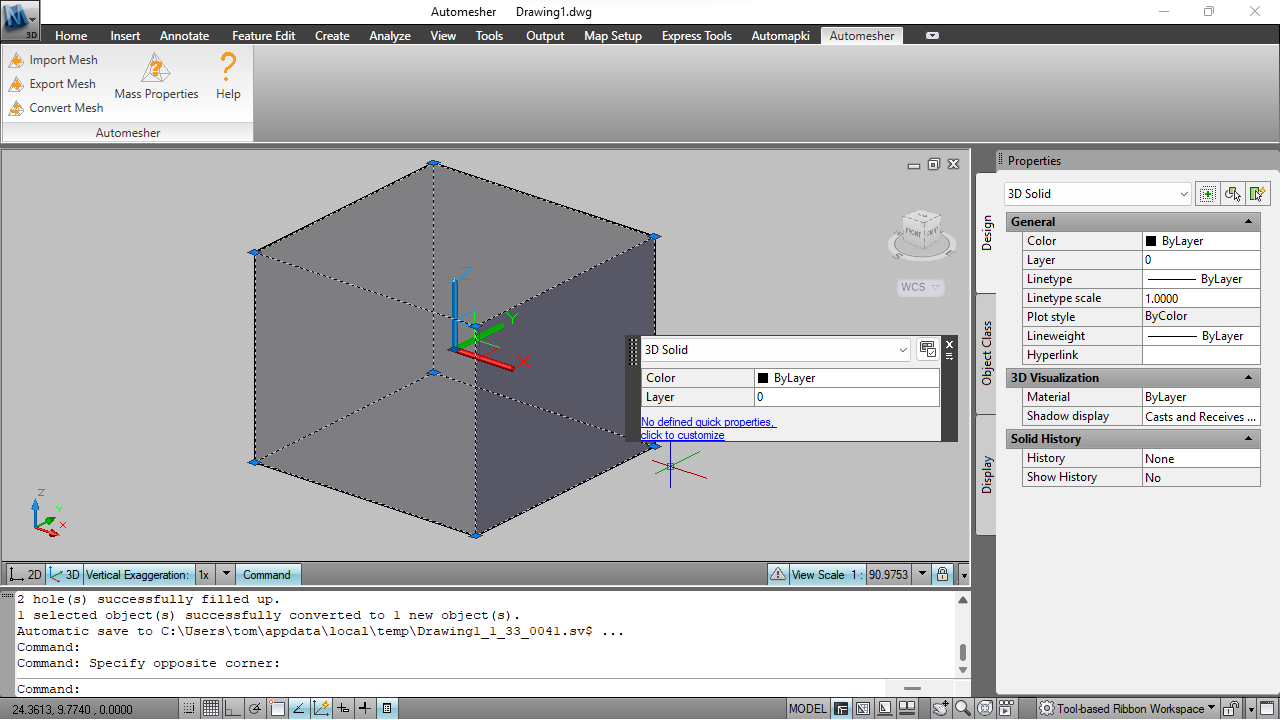
After conversion, a clean 3D solid body is inserted into the drawing at the same location as the original mesh. Verify the result by running the MASSPROP command on the converted solid - a valid watertight solid produces volume, centroid, and moment of inertia values. If MASSPROP returns no results or reports zero volume, the mesh still had non-manifold issues - try increasing the Fill Holes tolerance or manually inspecting the original mesh for severe geometry problems.
Why Hole Filling Is Required for Solid Conversion
A 3D solid in AutoCAD is defined by the ACIS kernel as a closed, bounded volume. For Automesher to generate this from a mesh, the mesh must form a completely closed surface - every point on the mesh must be surrounded by faces, with no gaps or openings. This is the mathematical definition of a watertight mesh.
The Fill Holes algorithm works by identifying all open boundary loops in the mesh (sequences of edges that have only one adjacent face) and generating new triangular faces that close each loop. Small holes - like those from missing triangles in a scan or gaps between assembled mesh pieces - are closed automatically. Very large holes may require manual mesh editing before the automated fill produces a geometrically meaningful result.
What Can You Do with the Watertight Solid?
Once the polyface mesh is converted to a watertight 3D solid, the full AutoCAD solid modeling toolkit becomes available:
- Boolean operations - use UNION, SUBTRACT, and INTERSECT to combine or cut the solid with other geometry
- Section and slice - apply section planes, SLICE, and SECTION commands to cut cross-sections through the solid
- Mass properties - run MASSPROP to calculate volume, surface area, centroid, and moments of inertia for engineering analysis
- STEP/SAT export - export the solid to STEP or SAT format for use in SolidWorks, CATIA, or other engineering CAD tools
- 3D printing preparation - export to STL for slicing, now with a validated watertight geometry that prints without errors
Frequently Asked Questions
-
What is a non-manifold mesh in AutoCAD?
A non-manifold mesh is one where the geometry violates the conditions required for a valid solid - specifically, open edges (edges with only one adjacent face), holes in the surface, or T-junctions (edges shared by three or more faces). AutoCAD cannot convert non-manifold meshes to 3D solids using standard commands.
-
Why does CONVTOSOLID fail on my polyface mesh?
AutoCAD's CONVTOSOLID command requires a watertight, manifold mesh. Any open boundary or non-manifold edge causes it to fail silently. Automesher's AmConvertMesh with Fill Holes enabled repairs these issues automatically before attempting the conversion.
-
How large a hole can Fill Holes close automatically?
The Fill Holes algorithm closes boundary loops of any size by triangulating the open boundary region. Small holes (from missing triangles or scan gaps) produce geometrically accurate patches. Very large holes or irregular openings may produce flat patches that approximate rather than reconstruct the original surface - manual mesh editing may be needed for complex cases.
-
Does this work in BricsCAD, ZWCAD, and GstarCAD as well?
Yes. Automesher Application runs identically in AutoCAD, BricsCAD, ZWCAD, and GstarCAD. The AmConvertMesh command and all conversion options are the same across all four platforms.
-
Is there a free trial?
Yes. Automesher Application is available as a free evaluation download with a limited number of conversions to test the full workflow before purchasing.
Summary
Non-manifold polyface meshes fail AutoCAD's standard CONVTOSOLID command because they have open boundaries, holes, or edge topology errors that prevent a valid closed solid from being generated. Automesher's AmConvertMesh command with Fill Holes enabled repairs these issues automatically, producing a watertight 3D solid ready for Boolean operations, engineering analysis, and 3D printing - in AutoCAD, BricsCAD, ZWCAD, and GstarCAD.
👉 Ready to convert? Download Automesher Application and try it free.