Rhino and SketchUp use fundamentally different geometry types - Rhino works with precise NURBS surfaces while SketchUp uses polygonal meshes. Converting a 3DM file to SKP format requires tessellating NURBS geometry into triangles and quads that SketchUp can display and edit.
This guide shows how to convert Rhino 3DM to SketchUp SKP in five steps using Autoconverter, including how to control tessellation quality and repair mesh errors before export. No Rhino or SketchUp installation required.
Why Converting 3DM to SKP Is Not Straightforward
SketchUp does not open 3DM files natively. Even if you use SketchUp Pro with its extended import options, Rhino's NURBS-based geometry has no direct equivalent in SketchUp's mesh-based format - the conversion always involves tessellation, which is the process of approximating smooth NURBS curves and surfaces as a mesh of flat triangular or polygonal faces.
The quality of that tessellation determines how smooth curved surfaces look in SketchUp. Too coarse and arcs appear faceted; too fine and the file becomes too heavy for smooth viewport performance. Getting this balance right is the key skill in 3DM to SKP conversion.
How to Convert 3DM to SKP: Step-by-Step
📥 Download and Install Autoconverter
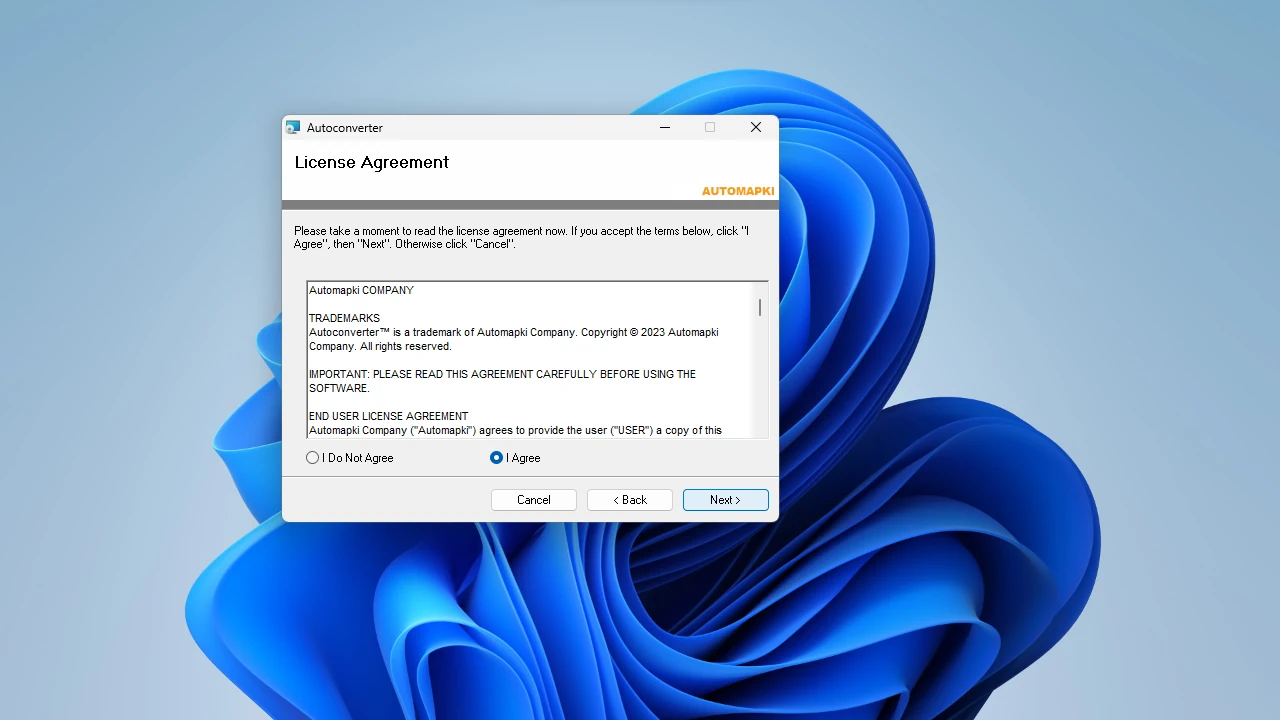
Download Autoconverter and install it on Windows. It reads Rhino 3DM files natively - including NURBS surfaces, polygon meshes, SubD geometry, and instance references - with no Rhino license required.
📂 Open Your Rhino 3DM File
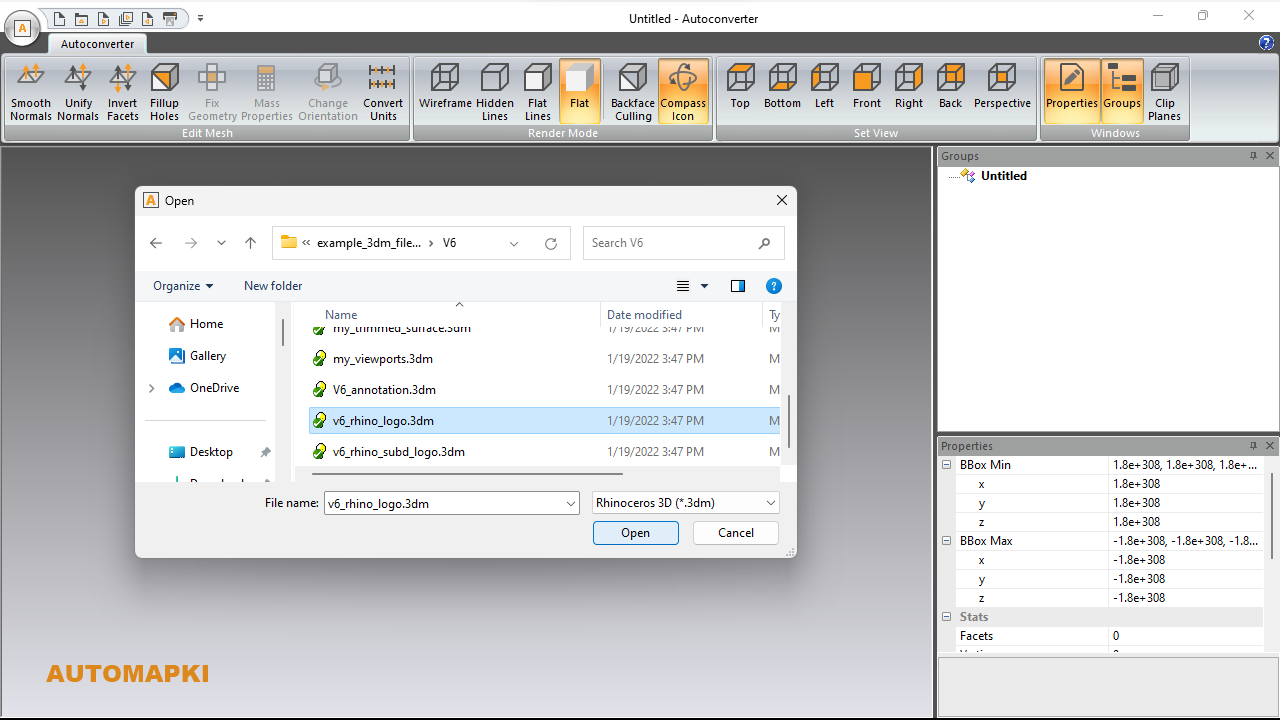
Click Open… and select your .3dm file, or drag and drop it into the application window. The model loads into the 3D viewport where you can inspect it before conversion. Autoconverter supports all Rhino versions from 2.x through the current Rhino 8.x.
🎛️ Set Tessellation Quality
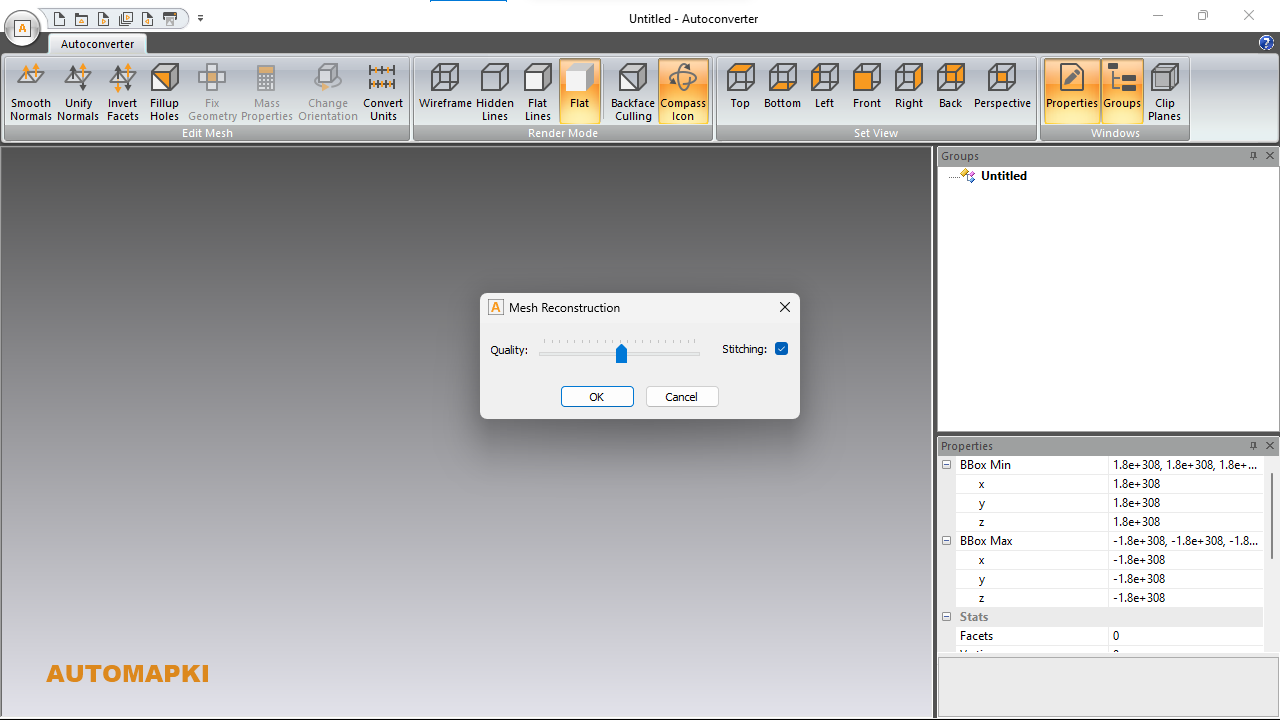
This is the most important step in any NURBS-to-mesh conversion. Before exporting, adjust the tessellation settings to control how finely NURBS surfaces are converted into polygon faces:
- Higher tessellation quality produces smoother curved surfaces in SketchUp at the cost of larger file size and more faces - use for presentation-quality models or close-up visualization.
- Lower tessellation quality reduces face count and file size - use for models that will be used as background context or when SketchUp performance is a priority.
- Medium tessellation is the practical default for most architectural and product design workflows where a balance of quality and performance is needed.
A good rule of thumb: start with medium quality, open the result in SketchUp, and increase tessellation only if curved surfaces look too faceted at your typical viewing distance.
🔧 Fix Geometry Errors
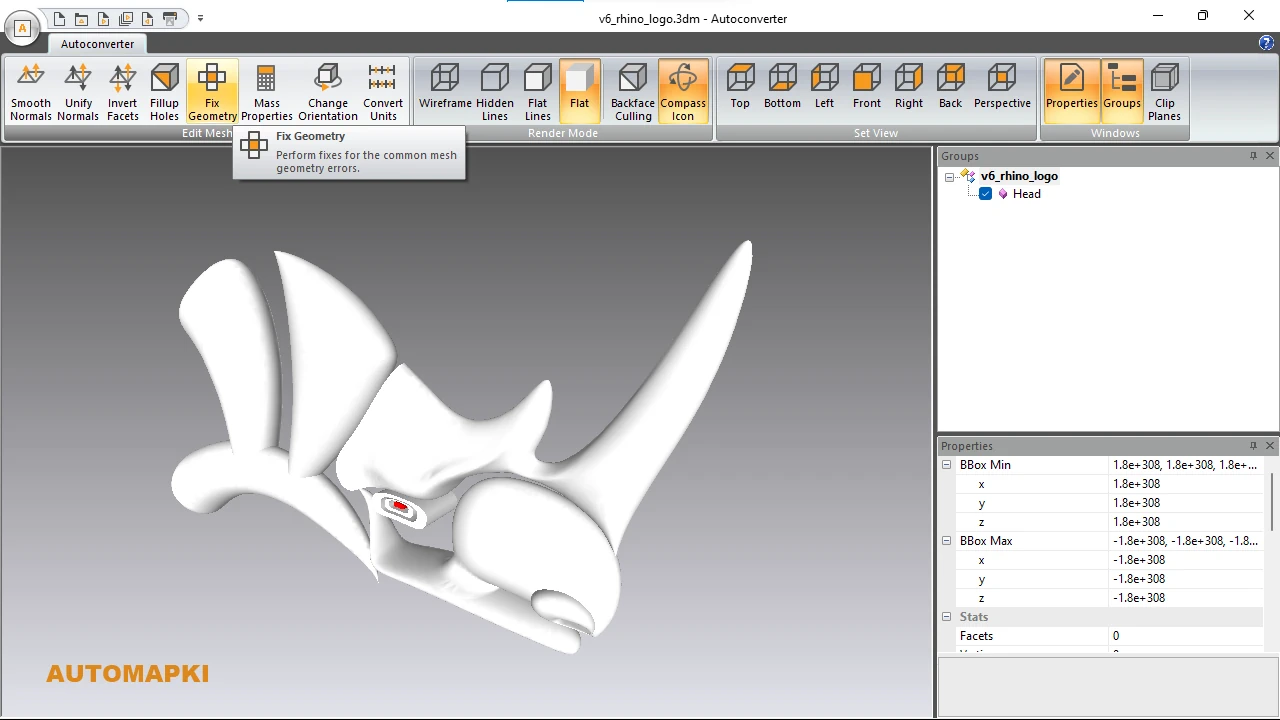
Rhino models sometimes contain geometry issues that cause problems in SketchUp - particularly open polysurfaces (surfaces with gaps between them) and non-manifold edges that SketchUp cannot display cleanly. Use Autoconverter's built-in repair tools before exporting:
- Fix Geometry repairs degenerate faces, flipped normals, and non-manifold edges in the tessellated mesh.
- Fill Holes closes gaps between polysurface pieces, producing a watertight mesh that SketchUp renders without interior faces showing through.
📤 Export to SKP Format
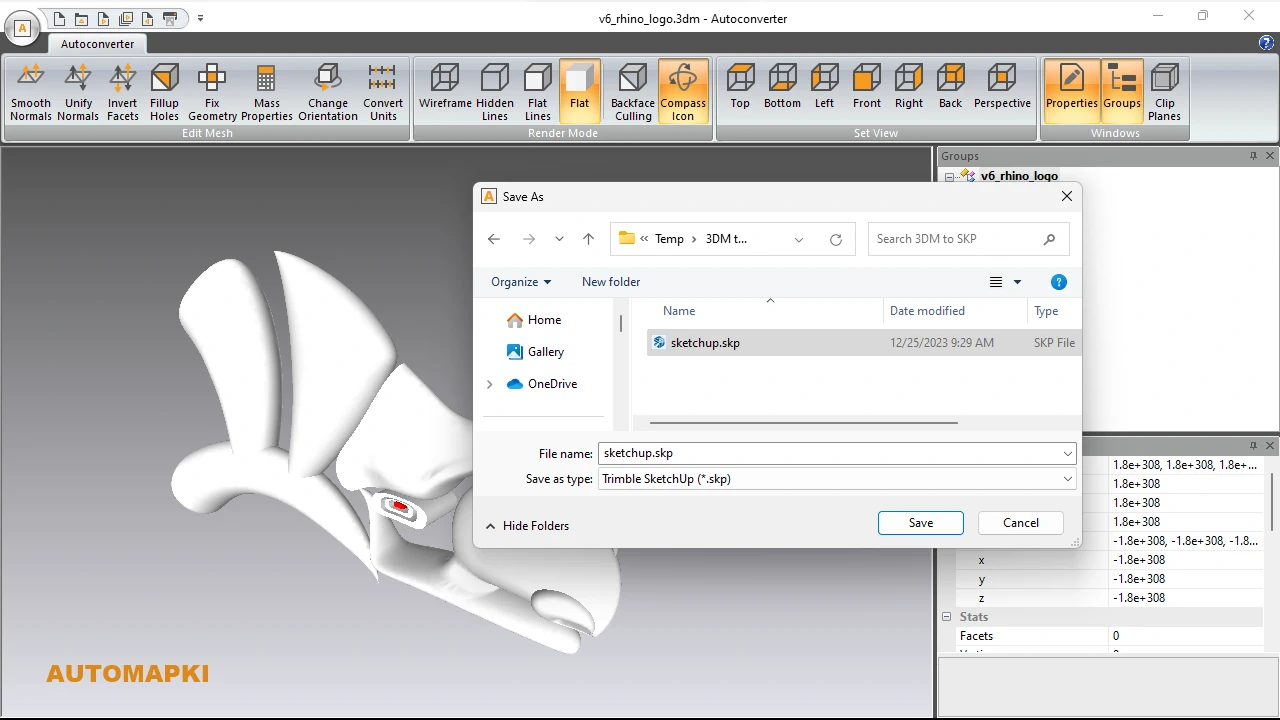
Click Save As… and select SketchUp SKP (*.skp) as the output format. If you need compatibility with a specific older SketchUp version, Autoconverter lets you choose the target SKP version at export - from SketchUp 3 through the latest release.
Frequently Asked Questions
-
Can I convert 3DM to SKP without Rhino or SketchUp installed?
Yes. Autoconverter reads 3DM files and writes SKP files natively - neither Rhino nor SketchUp needs to be installed on the machine performing the conversion.
-
Why do curved surfaces look faceted in SketchUp after conversion?
This is caused by low tessellation quality in Step 3. Increase the tessellation setting and reconvert - higher quality produces more polygon faces that better approximate the original NURBS curves. Use SketchUp's Soften Edges tool after import to smooth the appearance of curved surfaces without adding more faces.
-
Will Rhino layers be preserved in the SketchUp output?
Yes. Rhino layer names are converted to SketchUp tags (formerly called layers) in the output SKP file, preserving your model's organizational structure.
-
Can I choose which SketchUp version the SKP file targets?
Yes. Autoconverter lets you select the target SKP version at export - useful when the recipient is running an older version of SketchUp that cannot open newer SKP files.
-
Is there a free trial?
Yes. The free evaluation version of Autoconverter supports up to 10 file conversions. The full licensed version provides unlimited conversions and batch processing.
Summary
Converting Rhino 3DM files to SketchUp SKP requires tessellating NURBS geometry into polygonal meshes - and controlling tessellation quality is the key to a good result. Autoconverter handles the full pipeline: 3DM import, tessellation quality control, mesh repair, and SKP export with version selection, in five steps and without requiring Rhino or SketchUp on the conversion machine.
👉 Ready to convert? Download Autoconverter and try it free for up to 10 conversions.