Mass property analysis - volume, mass, centroid, moments of inertia - is typically a capability reserved for solid modeling CAD tools (AutoCAD MASSPROP, SolidWorks Mass Properties, CATIA). Polygon mesh formats like STL, OBJ, and PLY store geometry as triangle surfaces, not solid bodies, so most mesh tools cannot compute volumetric properties from them.
Autoconverter calculates mass properties directly from closed polygon mesh files - treating the mesh surface as the boundary of a solid volume and computing the enclosed properties. This works for STL, OBJ, PLY, 3DS, and all other mesh formats Autoconverter supports, without requiring conversion to a solid format first and without needing AutoCAD or any other CAD tool installed.
What Mass Properties Are Calculated
Autoconverter's Mass Properties function computes the following for any selected mesh group:
- Mass - the enclosed volume of the mesh, computed by integrating the divergence theorem over the closed mesh surface; requires a watertight mesh for accurate results
- Centroid (center of mass) - the 3D coordinates of the geometric center of the enclosed volume; equivalent to AutoCAD MASSPROP's centroid output
- Moments of inertia (Ix, Iy, Iz) - resistance to rotational acceleration around the X, Y, and Z axes; used in structural analysis, dynamic simulation, and robotics
- Products of inertia (Ixy, Ixz, Iyz) - cross-terms of the inertia tensor; needed for full 3D rotational dynamics
- Radii of gyration (Rx, Ry, Rz) - the equivalent radius at which the full mass would need to be concentrated to produce the same moment of inertia around each axis
- Principal moments and principal axes - the eigenvectors and eigenvalues of the inertia tensor; the orientations at which the inertia tensor is diagonal (no cross-coupling); essential for structural buckling analysis and rigid body dynamics
How to Calculate Mass Properties from a 3D Mesh File
📂 Open Your Mesh File
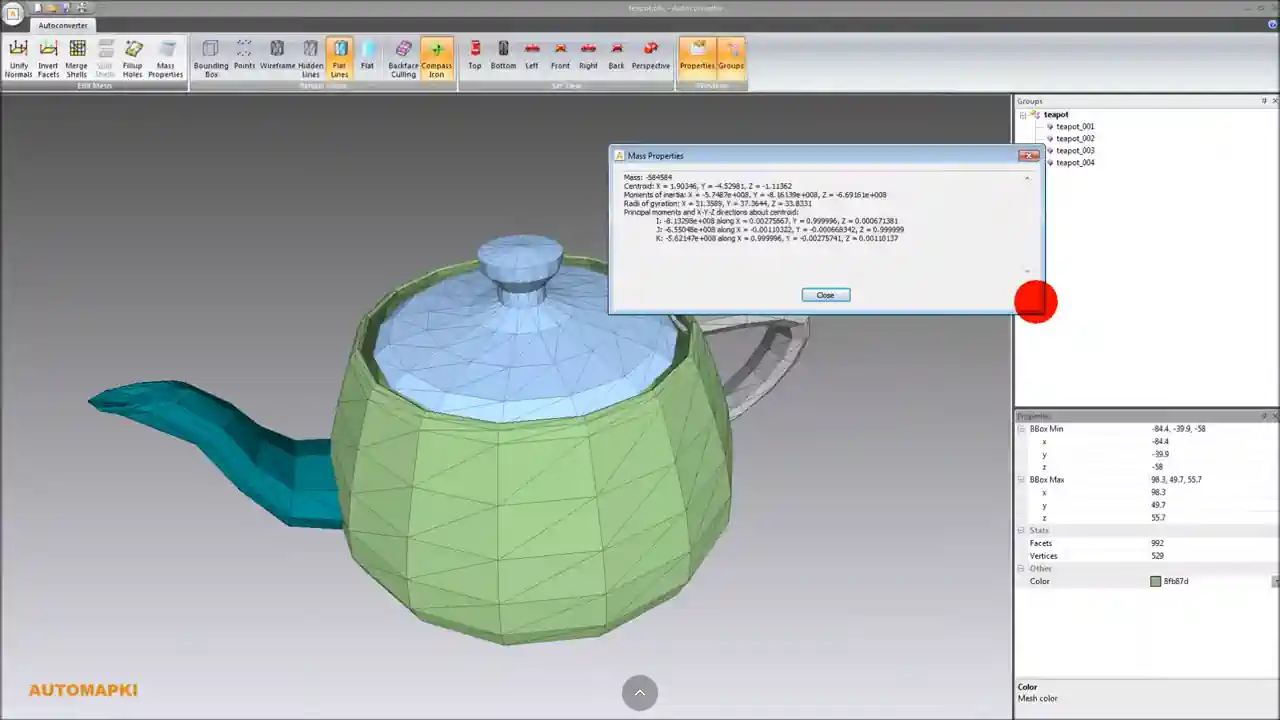
Launch Autoconverter and open your mesh file via File > Open or drag and drop. Supported formats include STL, OBJ, PLY, 3DS, FBX, DAE, SKP, STEP, and all other formats Autoconverter reads.
🎯 Select the Mesh to Analyze
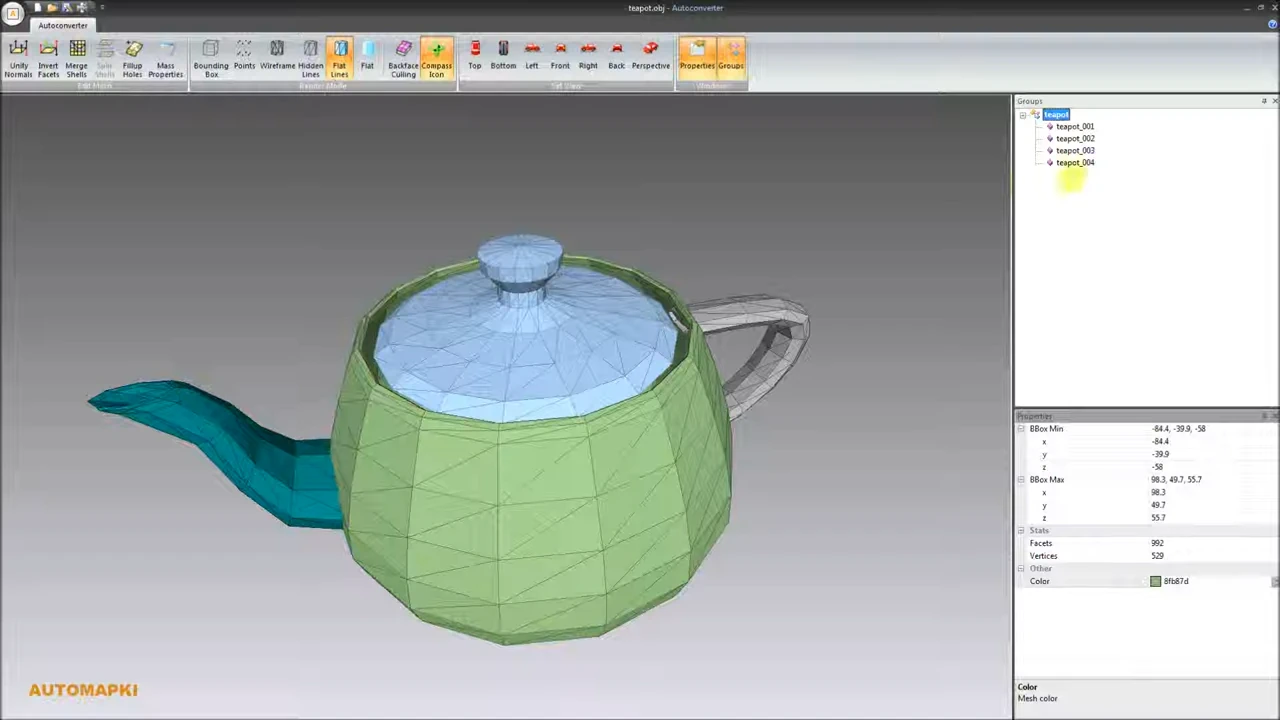
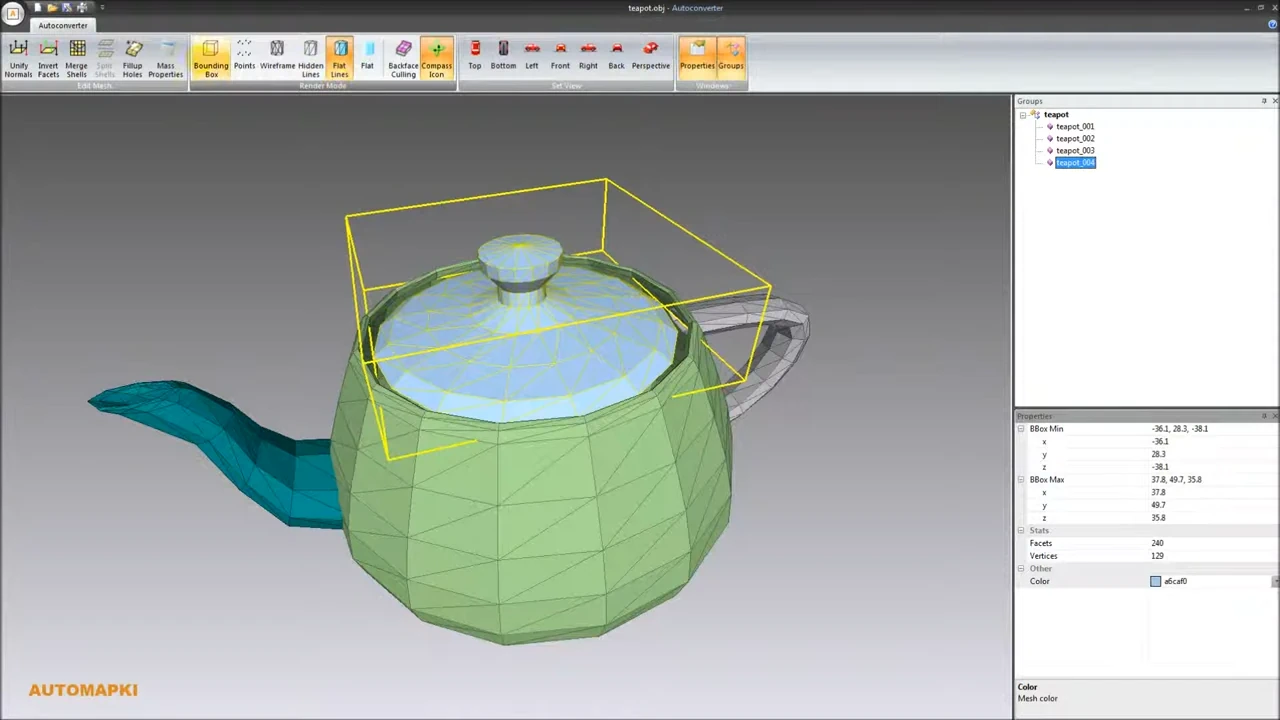
Select the mesh group to analyze - click on it in the 3D viewport or select it in the Groups Panel on the right. A yellow bounding box indicates the selected mesh. For multi-body files, select the specific body you want to analyze; you can also analyze all bodies together by selecting all groups.
📊 Calculate Mass Properties
Click Mass Properties in the Edit Mesh ribbon, or go to Edit > Mass Properties. The Mass Properties dialog opens and immediately displays the calculated values for the selected mesh.
📋 Review and Copy the Results
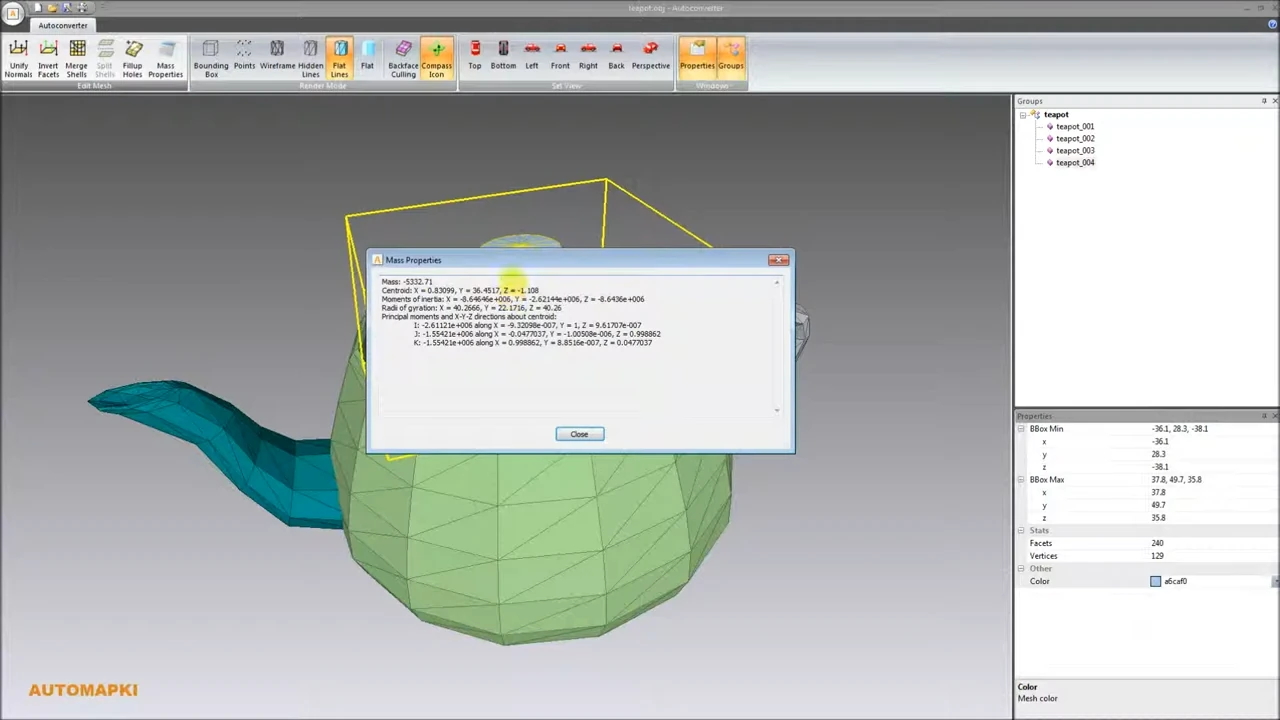
Read or copy the results - all values are displayed in the dialog and can be copied for use in engineering calculations, simulation setup, or documentation.
Mesh Requirements for Accurate Results
Mass properties calculated from mesh geometry depend on the mesh forming a closed (watertight) surface. An open mesh - one with holes, gaps, or missing faces - does not enclose a defined volume, and the calculated results will be incorrect.
Two common situations:
- 3D printed models and scan data (STL, PLY) - STL files from 3D printing workflows are typically watertight by requirement; scan-derived PLY files may have holes. Close holes in Autoconverter's mesh repair tools before calculating mass properties.
- OBJ / FBX / DAE from modeling tools - product visualization meshes are often open shells (surfaces without thickness) rather than closed solids. An open-shell mesh produces incorrect volume. Check the mesh is a closed manifold before relying on mass property results.
To verify the mesh is watertight before calculating: a valid closed mesh shows a non-zero, physically plausible volume. If volume appears near zero or negative, the mesh has open boundaries or reversed face normals.
Supported Input Formats for Mass Analysis
Any format Autoconverter can open can be used for mass property calculation:
- STL - the most common source format; watertight STL from 3D printing workflows gives reliable results
- OBJ - scan-derived or photogrammetry OBJ files; verify mesh closure before analysis
- PLY - 3D scan point cloud meshed to PLY; check for holes from scan occlusion
- 3DS - legacy 3D Studio mesh format
- FBX - product models from Maya, 3ds Max, or Blender
- STEP / IGES - engineering CAD geometry tessellated to mesh on import; typically produces closed meshes from solid model input
Frequently Asked Questions
Can I calculate mass properties from an OBJ file without CAD software?
Yes. Autoconverter calculates mass properties directly from polygon mesh files (OBJ, STL, PLY, and others) without requiring AutoCAD, SolidWorks, or any other CAD application. It is a standalone Windows application.
Why does my volume calculation show zero or a negative value?
A zero or negative volume indicates the mesh has open boundaries (holes in the surface) or reversed face normals pointing inward instead of outward. Use Autoconverter's mesh repair tools to fix normals and close holes, then recalculate. A valid closed mesh always returns a positive, non-zero volume.
Is there a free trial?
Yes. The free evaluation version of Autoconverter supports up to 10 file operations including mass property calculation. The full licensed version provides unlimited use.
Summary
Autoconverter calculates mass, volume, centroid, moments of inertia, products of inertia, radii of gyration, and principal moments directly from closed polygon mesh files - STL, OBJ, PLY, 3DS, STEP-derived meshes, and all other supported formats. No CAD software is required. Results are accurate for watertight closed meshes; open-shell meshes with holes or reversed normals will produce incorrect values. Use the built-in mesh repair tools to close holes before analysis.
👉 Ready to analyze? Download Autoconverter and try it free for up to 10 operations.