Mesh formats like STL and OBJ store geometry as triangle surfaces - useful for 3D printing and visualization, but not directly editable as solids in AutoCAD, SolidWorks, or other CAD tools that use the ACIS kernel. Converting to SAT (Standard ACIS Text) format bridges that gap: SAT is the native solid format used by AutoCAD, BricsCAD, ZWCAD, GstarCAD, and SolidWorks, enabling Boolean operations, solid editing, and manufacturing workflows on geometry that started as a mesh.
This guide shows how to convert mesh files to SAT in four steps using Autoconverter, including the mesh repair step that determines whether the output SAT is a valid closed solid.
What Is SAT Format and Why Convert to It?
SAT stands for Standard ACIS Text - a text-based solid geometry format produced by the ACIS geometric modeling kernel, which powers AutoCAD, SolidWorks, BricsCAD, and many other professional CAD tools. SAT files store solid body geometry including faces, edges, vertices, and topological relationships - everything needed for parametric editing, Boolean operations, section planes, and manufacturing analysis.
The key difference between a mesh and a SAT solid is geometric integrity. A mesh is a collection of flat triangles with no solid volume - it can't be edited as a solid, unioned with other geometry, or analyzed for mass properties. A SAT solid is a proper volumetric body with all geometric relationships intact. Converting mesh to SAT is therefore required whenever mesh geometry needs to enter a CAD solid modeling workflow.
Supported Input Formats
Autoconverter converts the following formats to SAT:
- STL - from 3D printers, scanners, and FDM/resin modeling
- OBJ - from Blender, Maya, 3ds Max, and online 3D repositories
- SKP - from SketchUp architectural and product models
- 3DM - from Rhinoceros 3D NURBS models
- DAE - from Collada interchange files
- STEP / STP - from engineering CAD systems (SolidWorks, CATIA, Creo)
- IGES / IGS - from legacy engineering exchange files
- 3DS - from 3ds Max legacy files
- PLY - from 3D scanning and point cloud workflows
- IFC - from BIM tools (Revit, ArchiCAD)
- VRML / WRL - from web 3D and visualization formats
- OFF - from research and mesh analysis tools
How to Convert Mesh to SAT: Step-by-Step
📥 Download and Install Autoconverter
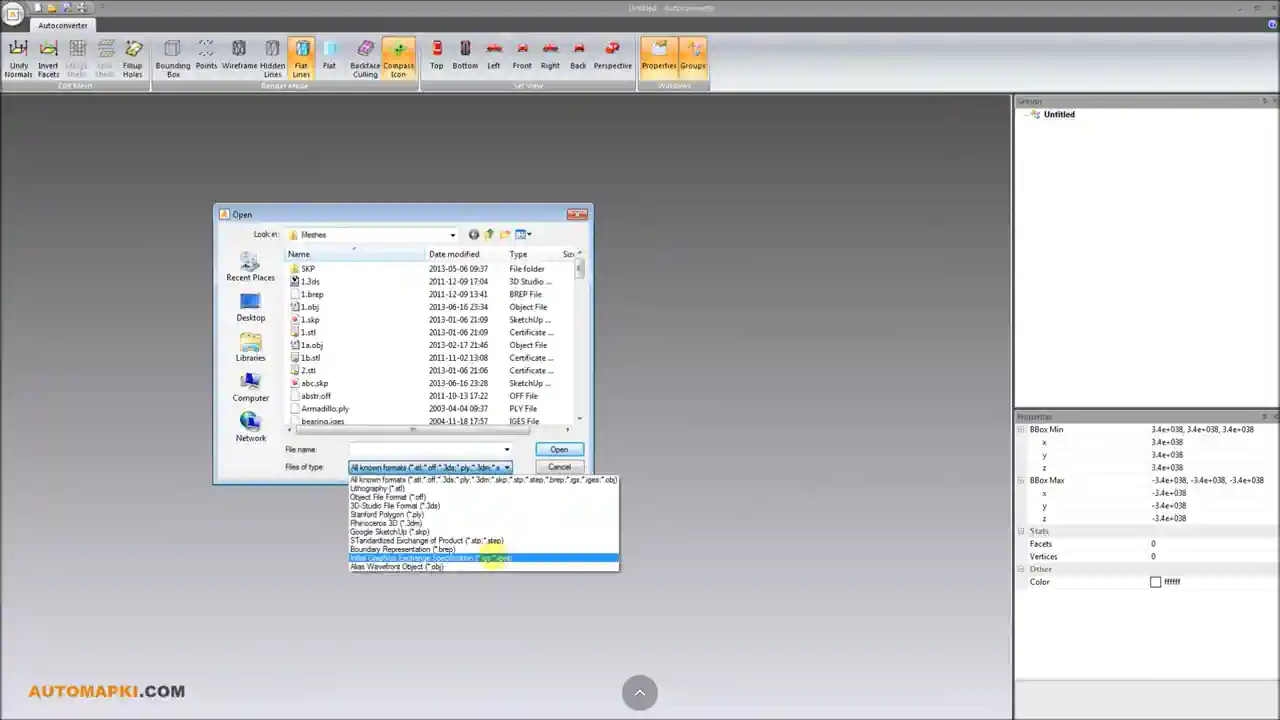
Download Autoconverter and install it on Windows. It reads all the mesh formats listed above natively and exports SAT. No additional CAD software installation is required.
📂 Open Your Mesh File
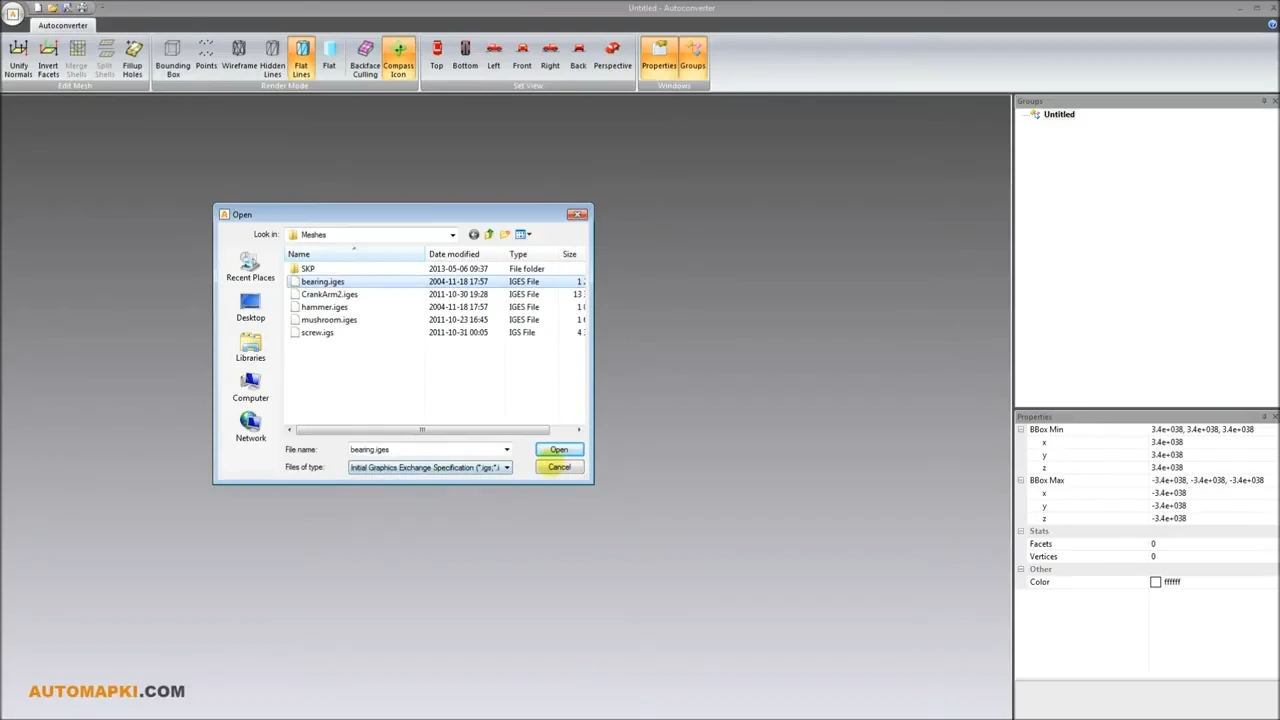
Click Open… and select your source file - STL, OBJ, SKP, 3DM, STEP, or any other supported format. The model loads into the 3D viewport. Inspect the geometry before proceeding to ensure the file loaded correctly and the mesh appears complete.
🔧 Repair the Mesh Before Exporting
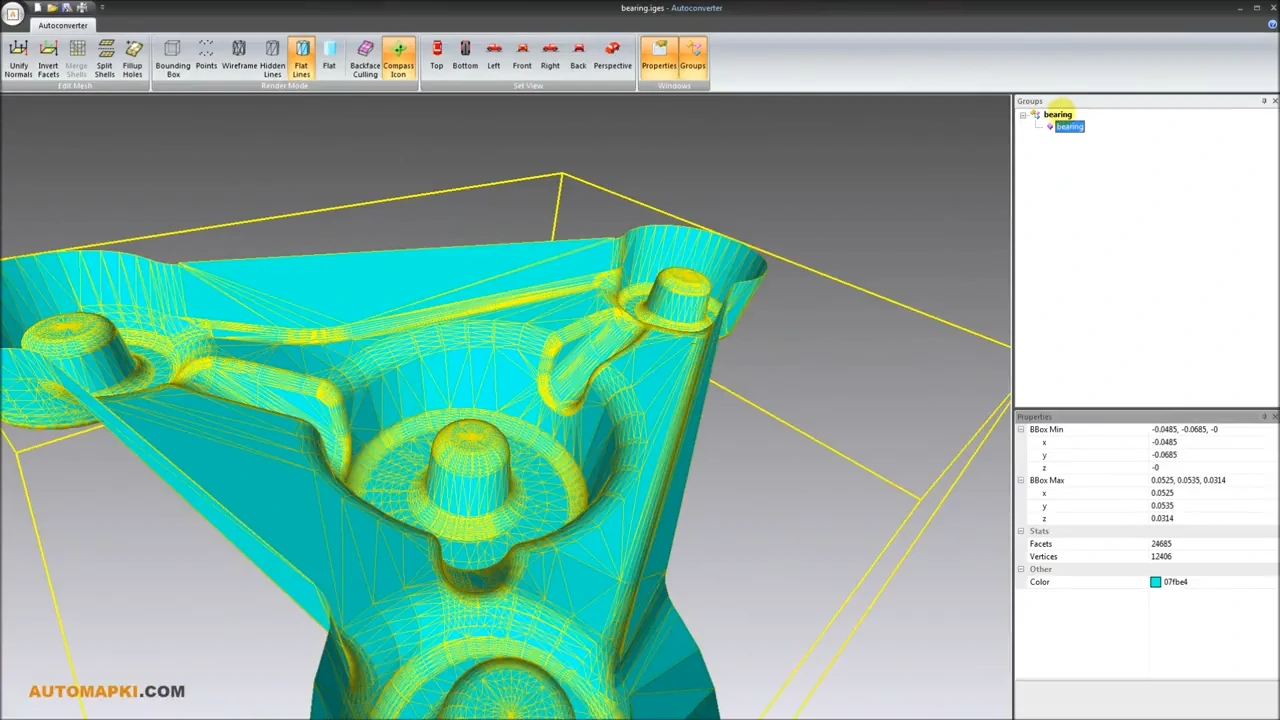
This is the most critical step in mesh-to-SAT conversion. ACIS solid bodies require watertight, manifold geometry - every edge must be shared by exactly two faces, and there must be no holes or gaps in the surface. Most real-world mesh files contain errors that prevent valid SAT output without repair.
Use Autoconverter's built-in mesh repair tools before exporting:
- Fix Geometry - detects and repairs non-manifold edges, degenerate faces, flipped normals, and duplicate vertices that would cause invalid solid bodies in SAT output
- Fill Holes - closes open boundaries and gaps in the mesh surface to make it watertight - a hard requirement for a valid closed solid in SAT format
Skipping this step is the most common reason mesh-to-SAT conversion produces an empty, invalid, or unclosed SAT file that AutoCAD or SolidWorks cannot import as a solid body.
💾 Export to SAT Format
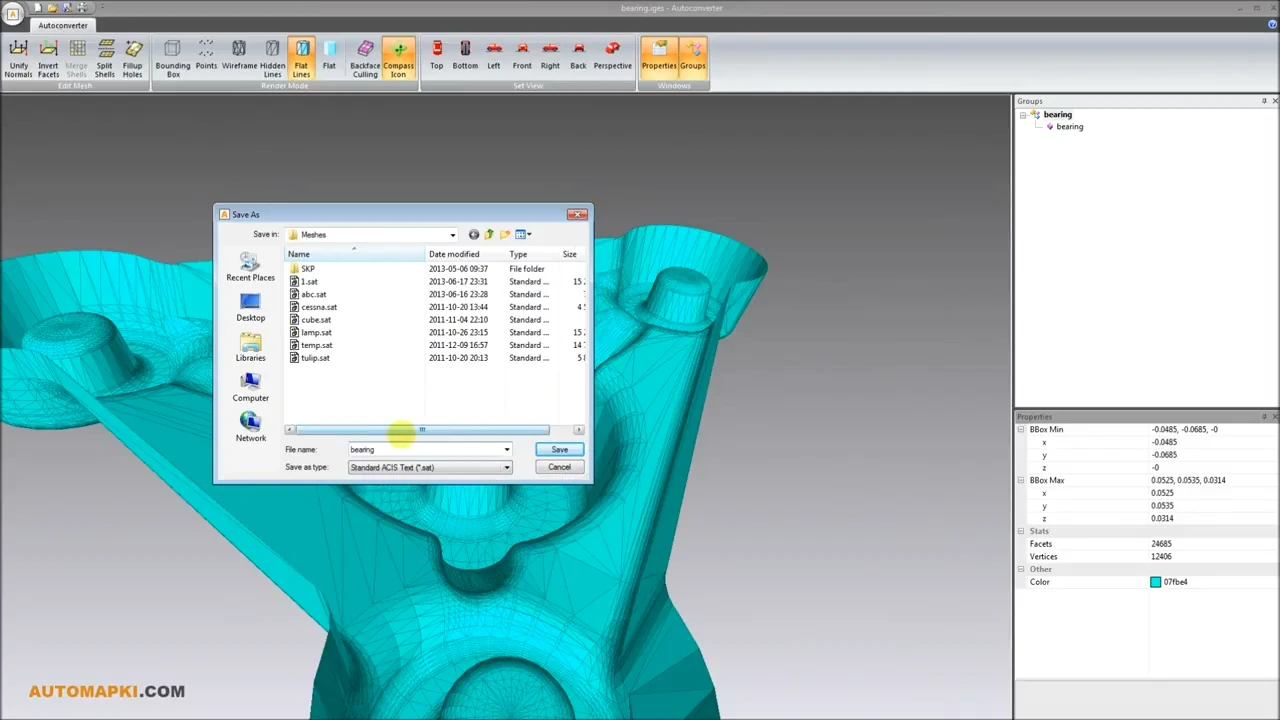
Click Save As… and select SAT (*.sat) as the output format. Choose your output filename and destination, then click Save. Autoconverter writes the mesh as faceted BREP (Boundary Representation) entities in the SAT file - the same representation used by AutoCAD's 3DSOLID objects, which means the file opens as a proper solid body in all ACIS-based CAD tools.
Mesh vs SAT Solid: Key Differences
| Feature | Mesh (STL, OBJ) | SAT Solid (ACIS) |
|---|---|---|
| Geometry type | Triangle surface only | Solid body with volume |
| Boolean operations | ❌ Not supported | ✅ Union, subtract, intersect |
| Solid editing | ❌ Mesh commands only | ✅ Full solid modeling commands |
| Mass properties | ❌ No volume data | ✅ Volume, centroid, moments of inertia |
| Section planes | Limited | ✅ Full section and cut support |
| 3D printing | ✅ Native format | Requires conversion |
| CAD import | Mesh import only | ✅ Imports as editable 3D solid |
Frequently Asked Questions
-
Why does AutoCAD import my SAT file as a mesh instead of a solid?
This happens when the mesh was not watertight before conversion - the resulting SAT contains an unclosed shell rather than a solid body. Ensure the Fill Holes and Fix Geometry repair tools were run in Step 3 before exporting to SAT, then reconvert.
-
What is the difference between SAT and STEP for importing into AutoCAD?
Both SAT and STEP can import solid geometry into AutoCAD as 3D solid objects. SAT is AutoCAD's native format (using the ACISIN command); STEP is an ISO-standard format (using the STEPIMPORT command in AutoCAD Mechanical or via Automesher). For standard AutoCAD, SAT is the most direct path for solid import.
-
Can I convert STEP files to SAT as well as mesh files?
Yes. Autoconverter supports STEP and IGES as source formats in addition to mesh formats. Converting STEP to SAT is useful when you need to import geometry from SolidWorks, CATIA, or other engineering CAD tools into standard AutoCAD as a solid body.
-
Is there a free trial?
Yes. The free evaluation version of Autoconverter supports up to 10 file conversions. The full licensed version provides unlimited conversions and batch processing.
Summary
Converting mesh files to SAT solid format requires a watertight, manifold mesh - the mesh repair step is not optional. Autoconverter handles the repair and conversion in four steps, producing SAT output that imports as a valid 3D solid body in AutoCAD, BricsCAD, ZWCAD, GstarCAD, SolidWorks, and Inventor.
👉 Ready to convert? Download Autoconverter and try it free for up to 10 conversions.