Autoconverter's GUI is convenient for one-off conversions, but for automated pipelines - folder-watch workflows, CI/CD steps, scheduled batch jobs, or scripted asset preparation - the command line interface is faster and more reliable. Every conversion that can be done through the GUI can also be done from the Windows command line, with full control over format, version, units, and tessellation quality.
This guide covers the complete Autoconverter CLI syntax, all available parameters, practical conversion examples, and batch folder conversion patterns.
Installation and Setup
- Download Autoconverter from the product page and run the installer (Autoconverter.msi for 32-bit or Autoconverter-x64.msi for 64-bit Windows).
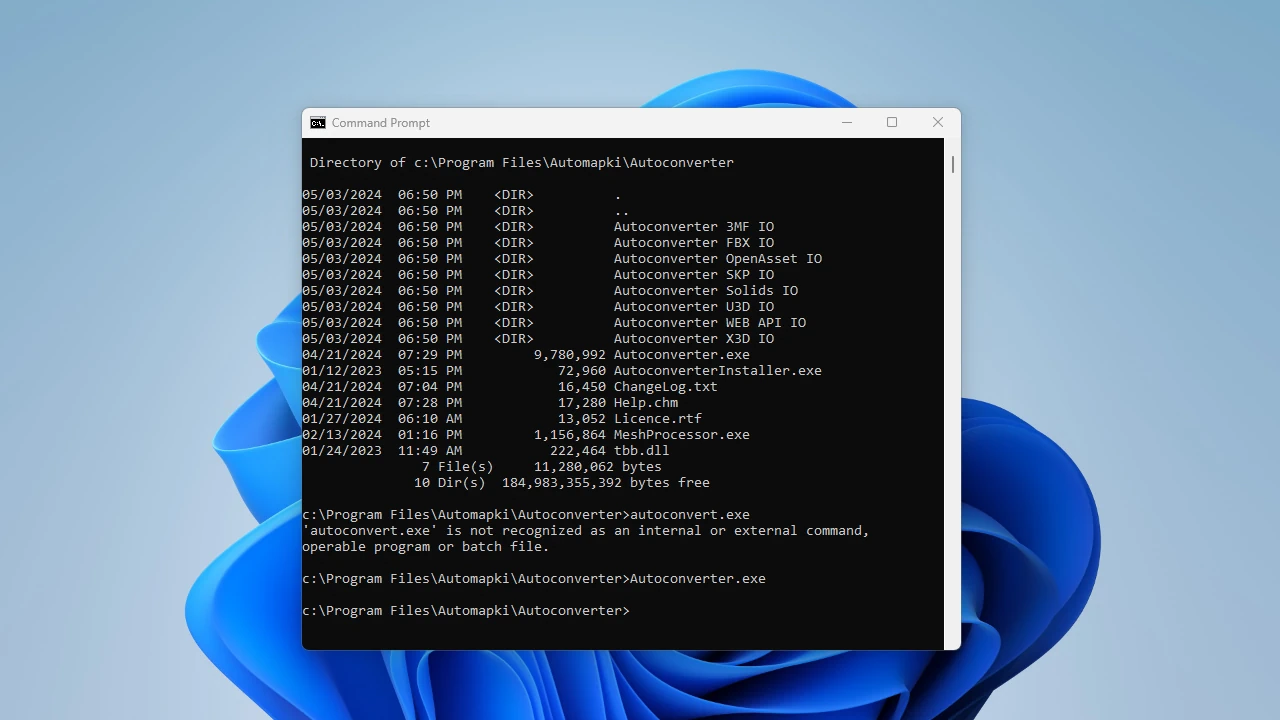
- After installation, the Autoconverter executable is at:
C:\Program Files\Automapki\Autoconverter\Autoconverter.exe - Open Command Prompt (Start → type
cmd→ Enter) and navigate to the installation directory, or add it to your system PATH for use from any directory.
CD "C:\Program Files\Automapki\Autoconverter"Basic Command Syntax
Autoconverter.exe -in "input_file" -out "output_file" [options]The output format is determined by the file extension in the -out path. No explicit format flag is needed - .skp produces SKP, .stl produces STL, .fbx produces FBX, and so on.
Complete Parameter Reference
| Parameter | Values | Description |
|---|---|---|
-in | file path | Input file path. Use quotes for paths with spaces. |
-out | file path | Output file path. Extension determines output format. |
-file_version | version string | Output file format version. Examples: "SketchUp 2021", "SketchUp 2017", "FBX 2014" |
-file_type | type string | Format subtype where applicable. For STL: Binary or ASCII. For GLTF: Embedded or Separate. |
-tessellation | 0–100 | NURBS tessellation quality for STEP/IGES input. 0 = coarse; 100 = fine. Default is 20. |
Common Conversion Examples
OBJ to SKP (specific SketchUp version)
Autoconverter.exe -in "model.obj" -out "model.skp" -file_version "SketchUp 2021"OBJ to SKP (older version for legacy compatibility)
Autoconverter.exe -in "model.obj" -out "model_2017.skp" -file_version "SketchUp 2017"SKP to STL (binary - preferred for 3D printing)
Autoconverter.exe -in "model.skp" -out "model.stl" -file_type BinarySKP to STL (ASCII - for tools that require text STL)
Autoconverter.exe -in "model.skp" -out "model.stl" -file_type ASCIIOBJ to FBX (FBX 2014 - universally compatible)
Autoconverter.exe -in "model.obj" -out "model.fbx" -file_version "FBX 2014"Batch Folder Conversion with a Windows Script
To convert all OBJ files in a folder to SKP, create a .bat file with the following content:
@echo off
SET INPUT_DIR=C:\models\input
SET OUTPUT_DIR=C:\models\output
SET AUTOCONVERTER="C:\Program Files\Automapki\Autoconverter\Autoconverter.exe"

FOR %%F IN ("%INPUT_DIR%\*.obj") DO (
    %AUTOCONVERTER% -in "%%F" -out "%OUTPUT_DIR%\%%~nF.skp" -file_version "SketchUp 2021"
    echo Converted: %%~nxF
)
echo Batch conversion complete.
Save as convert_all.bat, update the paths, and run it from Command Prompt or Task Scheduler for scheduled automated conversion.
PowerShell variant (for more complex pipeline integration)
$autoconverter = "C:\Program Files\Automapki\Autoconverter\Autoconverter.exe"
$inputDir = "C:\models\input"
$outputDir = "C:\models\output"

Get-ChildItem "$inputDir\*.obj" | ForEach-Object {
    $outFile = Join-Path $outputDir ($_.BaseName + ".skp")
    & $autoconverter -in $_.FullName -out $outFile -file_version "SketchUp 2021"
    Write-Host "Converted: $($_.Name)"
}
Frequently Asked Questions
How do I find the Autoconverter executable path?
The default installation path is C:\Program Files\Automapki\Autoconverter\Autoconverter.exe for 64-bit and C:\Program Files (x86)\Automapki\Autoconverter\Autoconverter.exe for 32-bit. To use Autoconverter from any directory without specifying the full path, add the installation folder to the Windows system PATH environment variable.
Can I use the CLI in PowerShell or batch scripts?
Yes. Autoconverter runs as a standard Windows executable and can be called from Command Prompt, PowerShell, batch scripts, Python subprocess, and any other process that can execute Windows programs. Use the full executable path or ensure the installation directory is in PATH.
What file formats are supported in the CLI?
All formats supported by Autoconverter's GUI are available from the CLI - including STL, OBJ, FBX, SKP, STEP, IGES, DAE, GLTF, 3DM, IFC, USD, 3MF, DWG, PLY, and 25+ others. The output format is determined by the file extension in the -out path.
Is there a free trial?
Yes. The free evaluation version of Autoconverter supports up to 10 file conversions including CLI use. The full licensed version provides unlimited conversions.
Summary
Autoconverter's CLI accepts -in and -out file paths and determines the output format from the file extension. Additional parameters control output file version (-file_version), STL/GLTF subtype (-file_type), and NURBS tessellation quality (-tessellation). Use a Windows batch file or PowerShell script to process entire folders unattended.
👉 Ready to automate? Download Autoconverter and try it free for up to 10 conversions.