AutoCAD's built-in CONVTOSOLID command works for simple, clean meshes - but it fails silently on complex geometry, open meshes, non-manifold edges, or meshes with holes. If you've run CONVTOSOLID and got nothing, or an error message with no useful explanation, this guide shows an alternative that handles those cases reliably.
This tutorial uses Automesher Application, a plugin for AutoCAD, BricsCAD, ZWCAD, and GstarCAD that adds a robust mesh-to-solid conversion command as an alternative to the native CONVTOSOLID.
Why CONVTOSOLID Fails on Polyface Meshes
AutoCAD's CONVTOSOLID command has strict requirements. It only succeeds when the input mesh is a valid, closed, watertight surface - meaning every edge is shared by exactly two faces and there are no holes or gaps anywhere in the mesh. Most real-world polyface meshes don't meet these criteria because they were imported from external formats (STL, OBJ, SKP, IFC), converted from 3D scans, or assembled from multiple parts with seam gaps.
Common reasons CONVTOSOLID fails include non-manifold edges (three or more faces sharing one edge), open boundaries and holes in the mesh surface, duplicate or degenerate faces from import, and meshes that are technically closed but have self-intersections. Automesher's AmConvertMesh command detects and repairs these issues automatically before attempting the solid conversion.
How to Convert Polyface Mesh to 3D Solid in AutoCAD
⚙️ Install Automesher Application
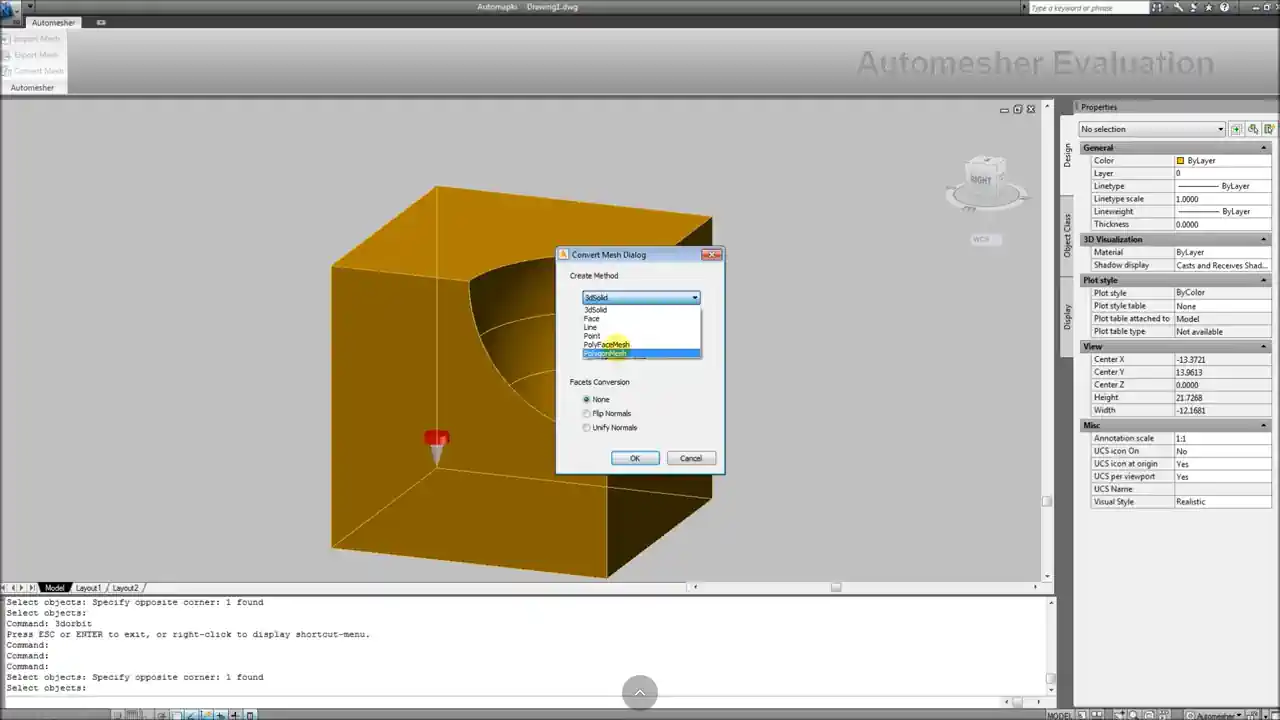
Download and install Automesher Application for your CAD platform - AutoCAD, BricsCAD, ZWCAD, or GstarCAD. After installation, restart your CAD application to autoload the plugin. A new Automesher menu or ribbon tab will appear confirming the plugin is active.
🖱️ Run AmConvertMesh Command
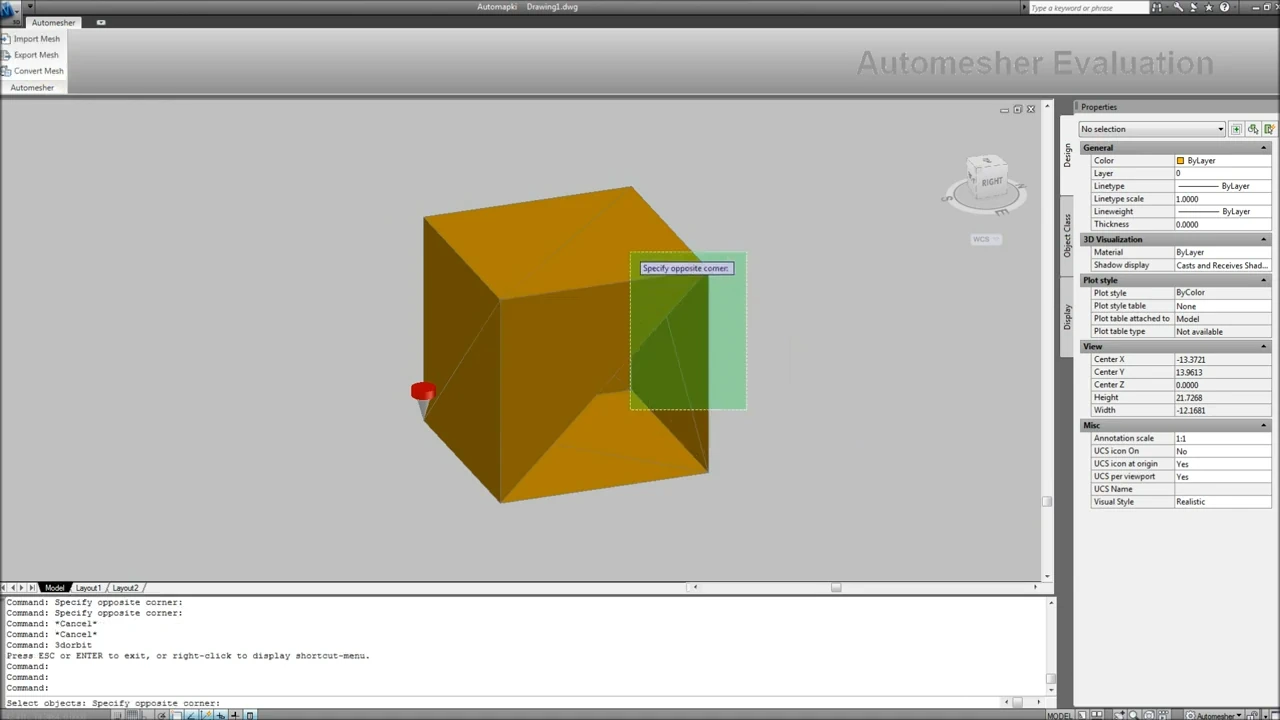
Open your DWG drawing containing the polyface mesh. Type AmConvertMesh in the AutoCAD command line and press Enter. Select the polyface mesh object you want to convert and press Enter again to confirm the selection.
🎛️ Configure Conversion Options
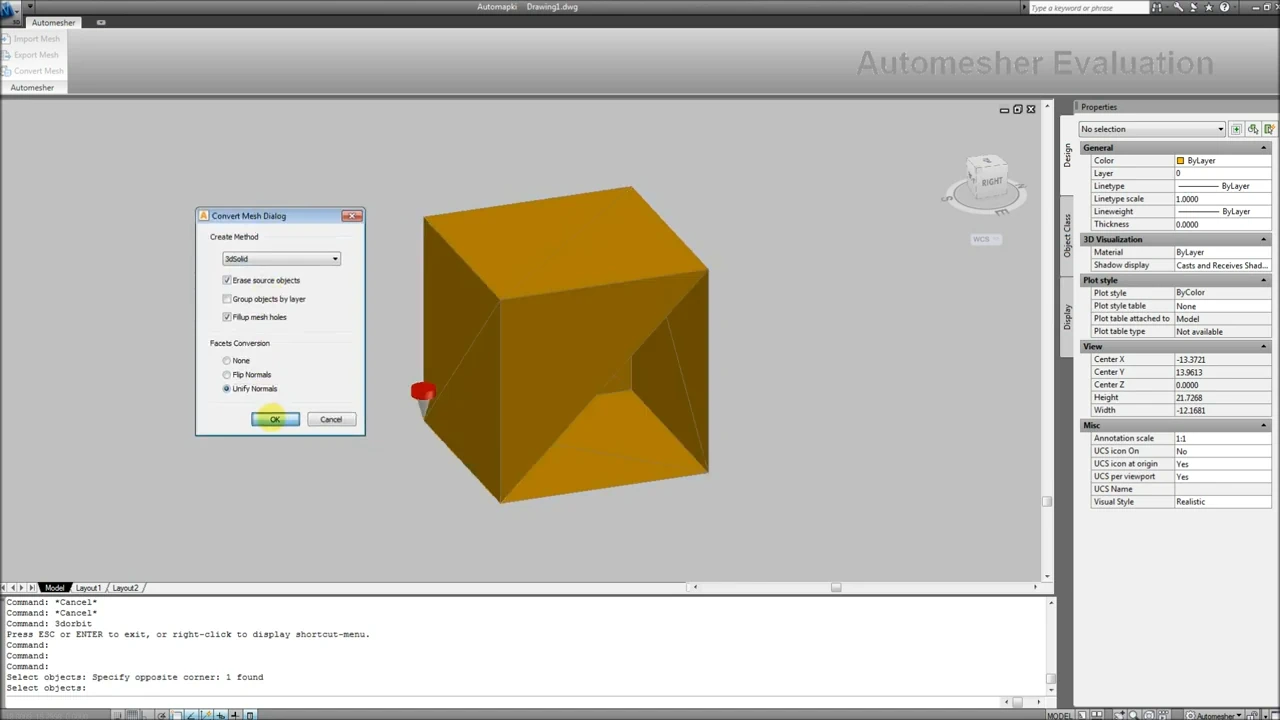
The conversion dialog offers several settings that control how the mesh is processed. For most polyface mesh to solid conversions, use the following configuration:
- Convert to 3dSolid - produces a true AutoCAD 3D solid body (ACIS-based) that supports Boolean operations, section planes, and all standard solid editing commands
- Fill Mesh Holes - automatically closes gaps and open boundaries in the mesh before conversion, which is the most common reason CONVTOSOLID fails
- Erase Source Entities - removes the original polyface mesh after conversion so you don't end up with duplicate geometry in the same location
- Group by Layer - assigns the resulting solid to the same layer as the source mesh, preserving your drawing's layer organization
Click OK to start the conversion. Automesher processes the mesh, repairs geometry issues, and creates the 3D solid in place.
🖥️ Verify the Result
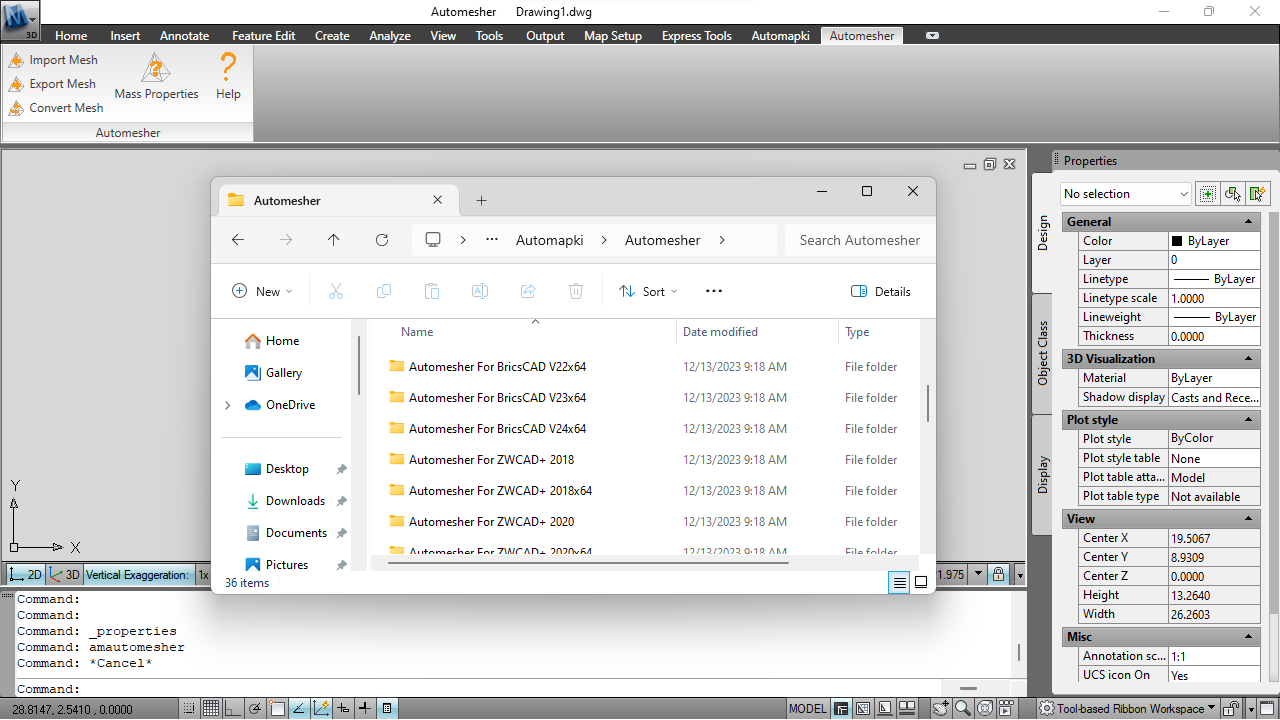
After conversion, use AutoCAD's Properties panel to confirm the object type is now 3D Solid. You can also run the MASSPROP command on the converted solid to verify it has valid volume and mass properties - a solid without valid mass properties may indicate the conversion produced an incomplete body.
Conversion Options Explained
Choosing the right settings in Step 3 makes a significant difference in output quality. Here's when to use each option.
Fill Mesh Holes should always be enabled when converting imported meshes, 3D scan data, or models assembled from multiple parts - these almost always have gaps. Disable it only when you intentionally want an open shell rather than a closed solid.
Convert to 3dSolid produces a true ACIS solid body. If your workflow requires a faceted representation rather than a solid (for example, for downstream STL export), choose Convert to 3dFace instead. The solid option is correct for FEA, CNC machining prep, and section/annotation workflows.
Group by Layer is useful when converting large assemblies with multiple meshes across different layers - it preserves your layer structure automatically instead of placing all solids on a single layer.
Frequently Asked Questions
-
Why does CONVTOSOLID say "Unable to convert selected objects"?
This error means the mesh is not watertight - it has open boundaries, non-manifold edges, or holes that prevent AutoCAD from building a valid solid body. Automesher's AmConvertMesh with Fill Mesh Holes enabled repairs these issues automatically before attempting conversion.
-
What is the difference between a polyface mesh and a 3D solid in AutoCAD?
A polyface mesh is a collection of flat triangular or polygonal faces with no volume information - AutoCAD treats it as surface geometry. A 3D solid is an ACIS-based volumetric body with valid mass properties, supports Boolean operations (union, subtract, intersect), and works with section planes, the MASSPROP command, and most manufacturing and analysis workflows.
-
Can I convert multiple polyface meshes to solids at once?
Yes. The AmConvertMesh command accepts a multi-object selection - select all the polyface meshes you want to convert before pressing Enter, and Automesher processes them all in one pass.
-
Will the converted solid look different from the original mesh?
The solid's geometry matches the mesh faces exactly - no smoothing or resampling occurs. The visual appearance in AutoCAD may differ slightly because solid bodies use a different display mode than polyface meshes, but the underlying geometry is the same.
-
Does Automesher work in BricsCAD and ZWCAD as well as AutoCAD?
Yes. Automesher Application is a native plugin for AutoCAD, BricsCAD, ZWCAD, and GstarCAD. The AmConvertMesh command and all conversion options work identically in all four platforms.
-
Is there a free trial?
Yes. Automesher Application is available as a free evaluation download. The trial version allows a limited number of conversions so you can test the full workflow before purchasing.
Summary
When AutoCAD's CONVTOSOLID fails on a polyface mesh, the cause is almost always mesh errors - holes, non-manifold edges, or open boundaries that AutoCAD can't handle natively. Automesher's AmConvertMesh command repairs these issues automatically and produces a true 3D solid body ready for Boolean operations, CNC prep, FEA, and all standard AutoCAD solid modeling workflows.
👉 Ready to convert? Download Automesher Application and try it free in AutoCAD, BricsCAD, ZWCAD, or GstarCAD.