Standard AutoCAD supports only a limited set of 3D import formats. If you need to bring in a STEP file from SolidWorks, an OBJ from Blender, a SKP from SketchUp, an IFC from a BIM tool, or an STL from a 3D scanner - none of those open natively in AutoCAD without additional software.
Automesher Application adds a full-featured 3D import pipeline to AutoCAD, BricsCAD, ZWCAD, and GstarCAD. This guide shows how to import external 3D files in five steps, including how to control the output entity type for each use case.
Supported Import Formats
Automesher supports a wide range of 3D source formats, covering engineering, design, and mesh-based workflows:
- STEP / STP - from SolidWorks, CATIA, Creo, NX, Inventor, and other CAD tools
- IGES / IGS - legacy engineering exchange format
- STL - from 3D printers, scanners, and mesh modeling tools
- OBJ - from Blender, Maya, 3ds Max, and other DCC tools
- SKP - from Trimble SketchUp (all versions)
- 3DM - from Rhinoceros 3D (Rhino 2.x through 8.x)
- DAE - Collada files from SketchUp, Maya, and other tools
- IFC - BIM models from Revit, ArchiCAD, and other BIM platforms
- 3DS - from legacy Autodesk 3ds Max files
- PLY - from point cloud and 3D scanning workflows
- VRML - web 3D and visualization format
- OFF - Object File Format for mesh geometry
How to Import 3D Files into AutoCAD: Step-by-Step
📥 Install Automesher Application
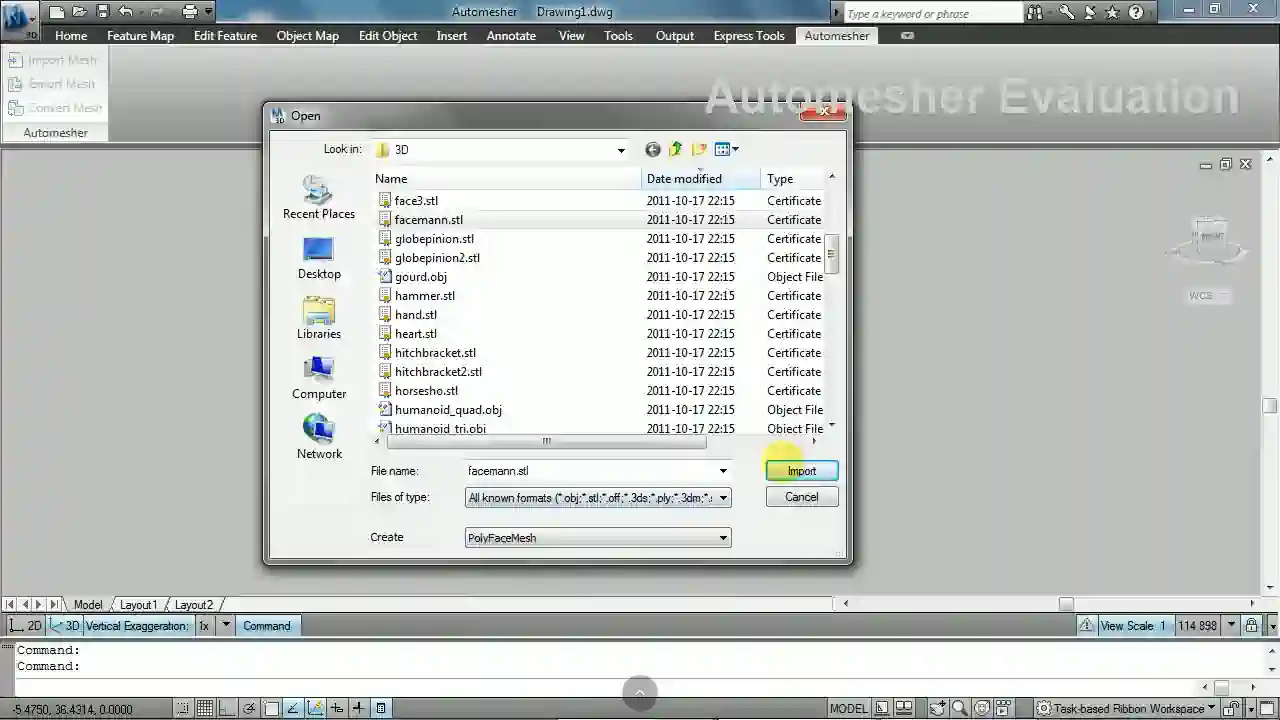
Download and install Automesher Application for your CAD platform - AutoCAD, BricsCAD, ZWCAD, or GstarCAD. After installation, restart your CAD application to autoload the plugin. Automesher adds a dedicated ribbon tab and the AmImportMesh command to your CAD environment.
🚀 Run the AmImportMesh Command
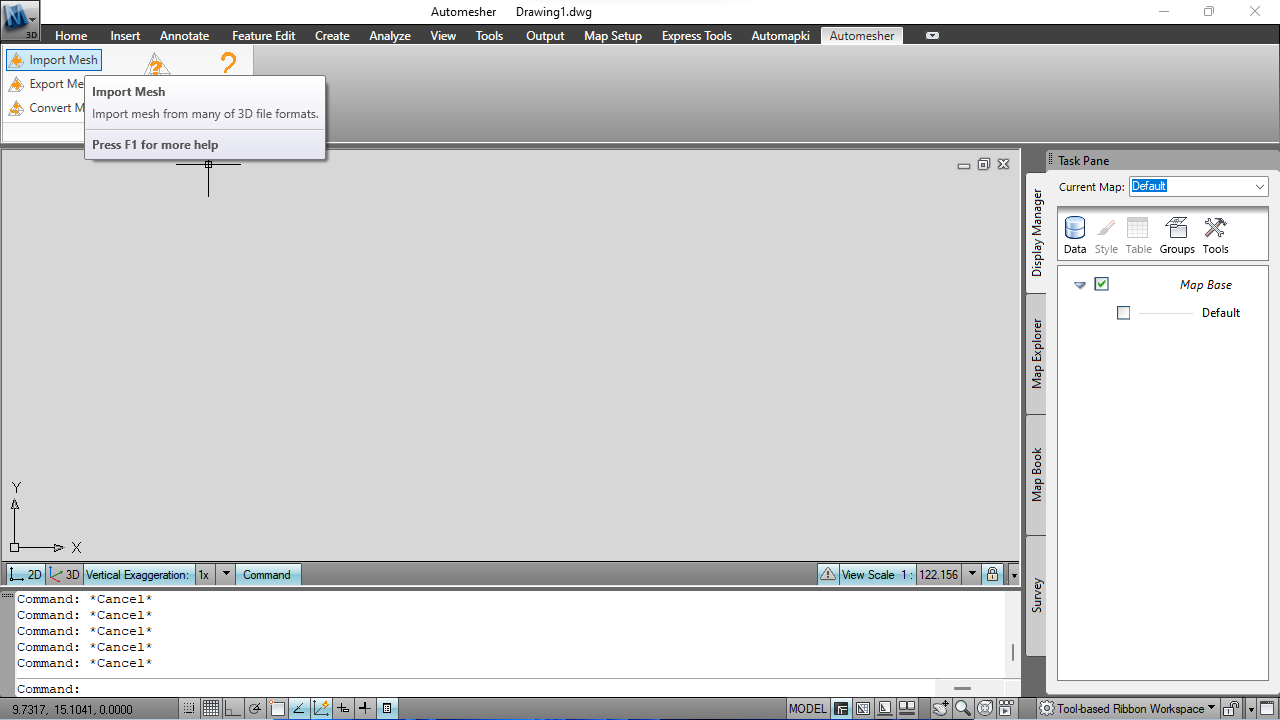
Open your target DWG drawing in AutoCAD. Type AmImportMesh in the command line and press Enter, or click the Import Mesh button in the Automesher ribbon. The import file dialog opens.
⚙️ Select the File Format and Source File
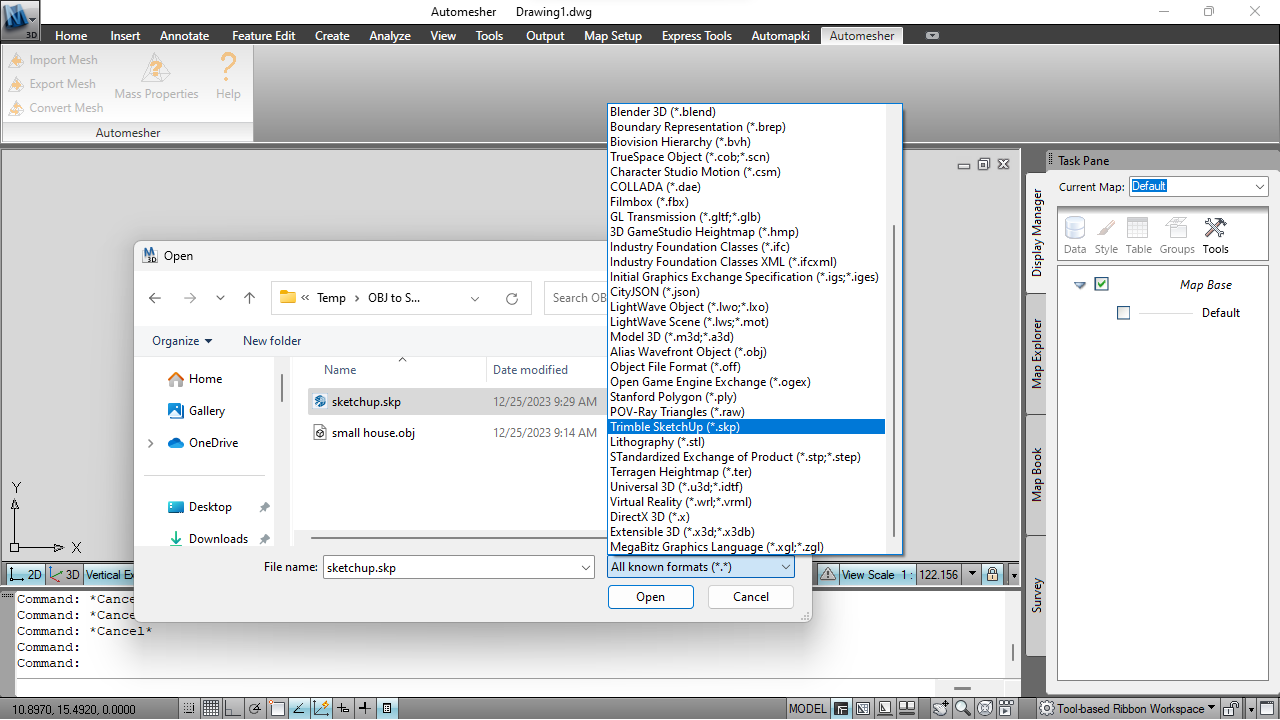
In the import dialog, select the appropriate file format filter from the dropdown - STEP, STL, OBJ, SKP, 3DM, IFC, DAE, IGES, or one of the other supported formats. Browse to your source file and click Open.
🧊 Choose the AutoCAD Entity Type
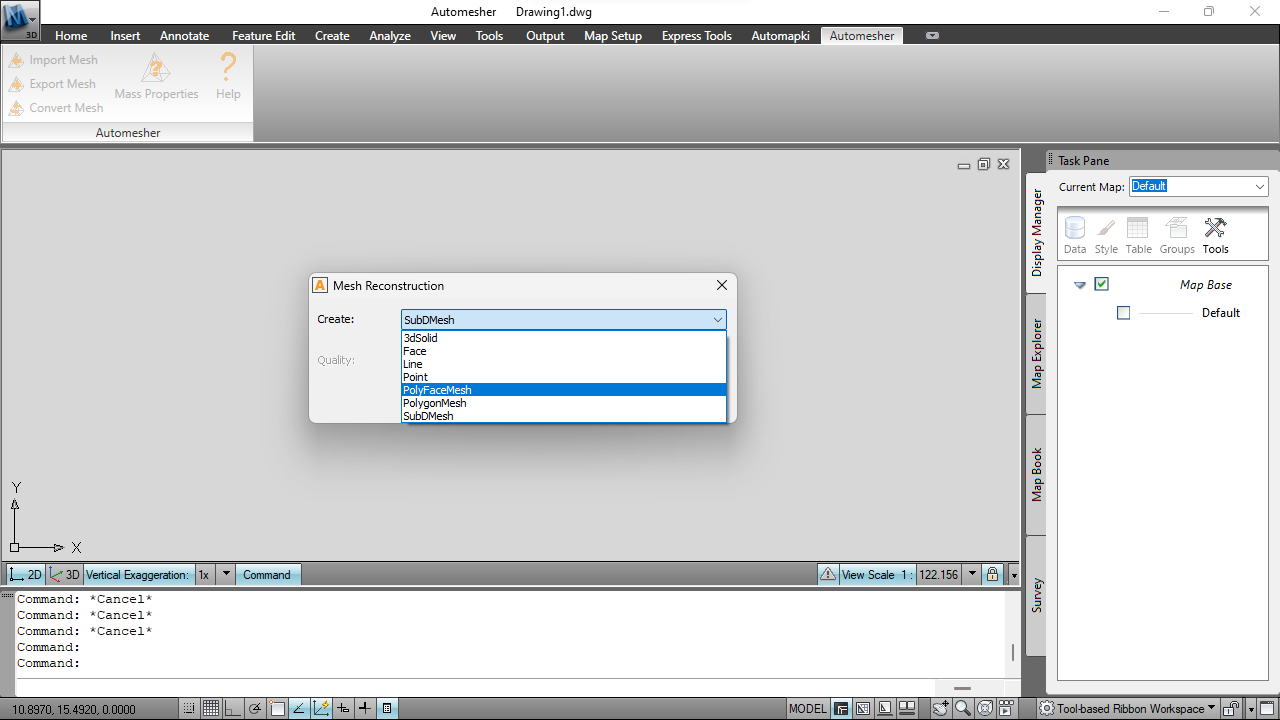
This is the most important step - it determines how the imported geometry appears in AutoCAD and what you can do with it:
- 3D Solid - imports as an ACIS-based solid body. Supports Boolean operations (union, subtract, intersect), section planes, MASSPROP, and all standard solid editing commands. Best for STEP and IGES files where the source geometry is solid bodies.
- Polyface Mesh - imports as a polyface mesh object. Editable with mesh commands; can be converted to 3D solid using Automesher's AmConvertMesh command. Best for STL, OBJ, and other mesh formats.
- Surface - imports as AutoCAD surface geometry. Useful when you need NURBS-like editing rather than solid body operations.
- SubD Mesh - imports as a subdivision surface object for freeform editing. Available in recent AutoCAD versions that support SubD.
- 3D Face - imports as individual 3D face entities. Most compatible option for legacy AutoCAD versions; simplest entity type.
Press Enter to confirm the entity type and complete the import. The geometry is placed in the AutoCAD model space at the origin.
✅ Position and Edit the Imported Geometry
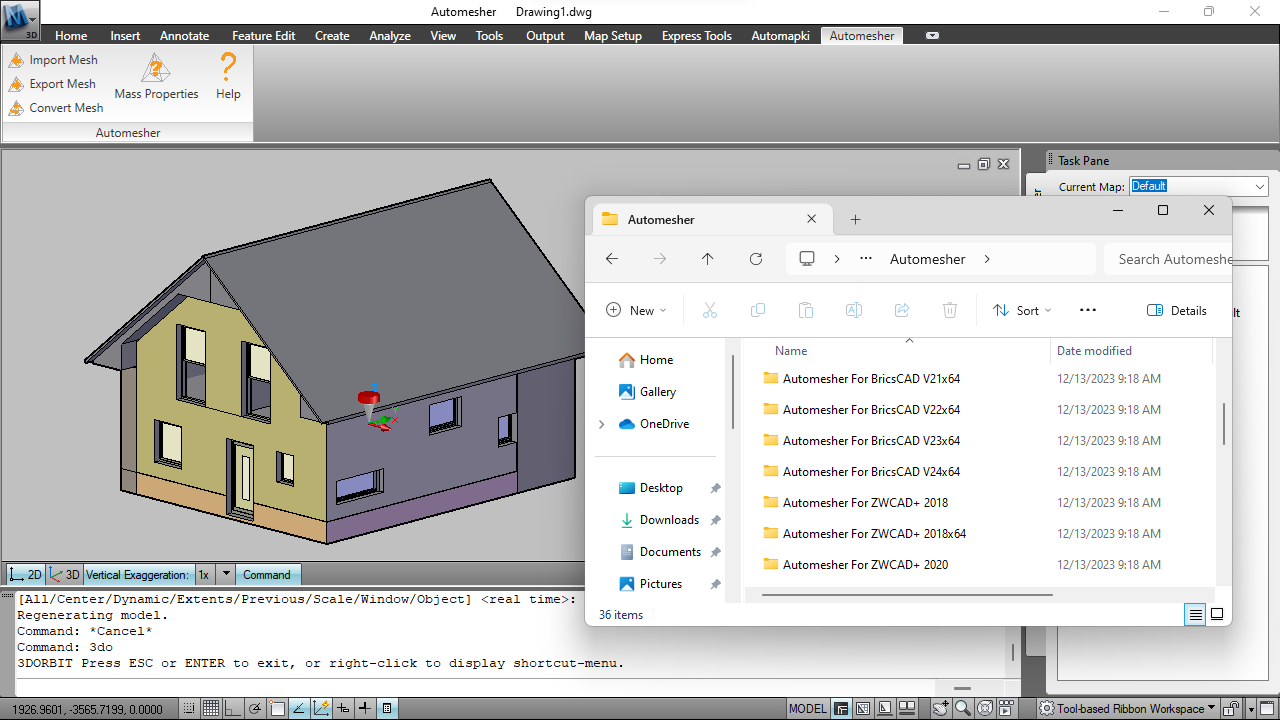
After import, use standard AutoCAD commands to move, rotate, scale, or edit the imported objects. For STEP and IGES imports as 3D solids, you can immediately run Boolean operations, use the section plane tool, or add dimensions. For mesh imports, use Automesher's AmConvertMesh command if you need to convert the mesh to a 3D solid for further editing.
Frequently Asked Questions
-
Can AutoCAD import STEP files natively?
Standard AutoCAD cannot import STEP files without a plugin. AutoCAD Mechanical and some verticals include limited STEP support, but standard AutoCAD requires Automesher for STEP import. Automesher adds STEP import (and 11+ other formats) to standard AutoCAD, BricsCAD, ZWCAD, and GstarCAD.
-
Can I import SKP files directly into AutoCAD?
Not natively. AutoCAD does not support SKP import without additional software. Automesher adds SKP import directly into AutoCAD, placing SketchUp geometry as AutoCAD entities in the active drawing.
-
What is the difference between importing as 3D Solid vs Polyface Mesh?
A 3D Solid is an ACIS-based volumetric body that supports Boolean operations, section planes, and engineering analysis commands. A Polyface Mesh is a surface-only object made of flat polygonal faces with no solid volume - it can be converted to a 3D Solid using Automesher's AmConvertMesh command if needed.
-
Can I import IFC (BIM) files into AutoCAD with Automesher?
Yes. IFC files from Revit, ArchiCAD, Tekla, and other BIM platforms are supported. The imported geometry can be placed as 3D Solid or Polyface Mesh objects in the AutoCAD drawing.
-
Is there a free trial?
Yes. Automesher Application is available as a free evaluation download. The trial allows a limited number of import operations so you can test the full workflow before purchasing.
Summary
Automesher Application extends AutoCAD's native import capabilities to cover STEP, STL, OBJ, SKP, 3DM, IFC, DAE, IGES, and more - bringing external 3D geometry into AutoCAD as fully editable 3D Solid, Polyface Mesh, Surface, or SubD entities. The same plugin works identically in BricsCAD, ZWCAD, and GstarCAD.
👉 Ready to import? Download Automesher Application and try it free.