STEP files (.step, .stp) store precise engineering geometry - NURBS surfaces, solid bodies, and B-Rep data - that most visualization, design, and 3D printing tools can't use directly. Converting STEP to a mesh format makes that geometry accessible in SketchUp, Blender, game engines, 3D printers, and any other tool that works with polygon mesh rather than CAD solids.
This guide shows how to convert STEP files to mesh formats using Autoconverter - covering every commonly needed output format from the same STEP source file, with no CAD software installation required.
Supported Output Formats from STEP
Autoconverter converts STEP files to the following mesh and CAD formats in a single step:
- SKP - for SketchUp architectural visualization and presentation
- OBJ - for Blender, Maya, 3ds Max, game engines, and rendering pipelines
- STL - for 3D printing (FDM, resin, SLS) and additive manufacturing
- FBX - for Unity, Unreal Engine, Maya, and animation pipelines
- 3DM - for Rhinoceros 3D surface modeling and fabrication
- DAE - for Collada-compatible cross-application interchange
- 3DS - for legacy Autodesk 3ds Max compatibility
- PLY - for point cloud and scanning workflows
- SAT - for AutoCAD, BricsCAD, and SolidWorks ACIS solid import
STEP vs Mesh Formats: What Changes in Conversion
STEP stores geometry as mathematically exact NURBS surfaces and solid bodies - every curve is defined by an equation, not by triangles. Mesh formats (STL, OBJ, SKP, FBX) represent geometry as polygon faces, which are an approximation of those exact surfaces.
Converting STEP to a mesh format is called tessellation - the NURBS surfaces are approximated by a grid of flat triangular faces. The finer the tessellation, the more closely the mesh approximates the original smooth geometry, and the larger the output file. For 3D printing, visualization, and game engines this trade-off is acceptable; for engineering and manufacturing workflows where geometric precision is required, keep the STEP file as-is or export to SAT instead.
How to Convert STEP to Mesh Formats: Step-by-Step
📥 Download and Install Autoconverter
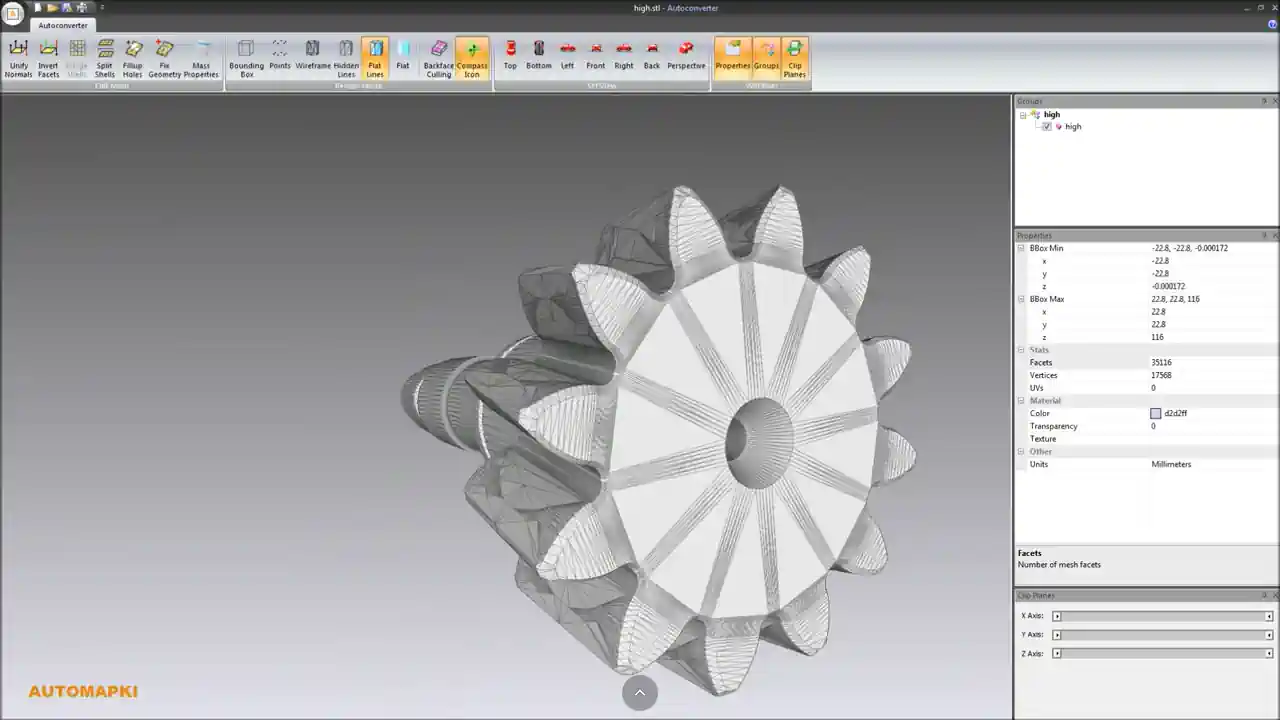
Download Autoconverter and install it on Windows. It reads STEP files natively using the Open Cascade geometric kernel - no SolidWorks, CATIA, or other CAD software is required. Launch it from the Windows Start menu.
📂 Open Your STEP File
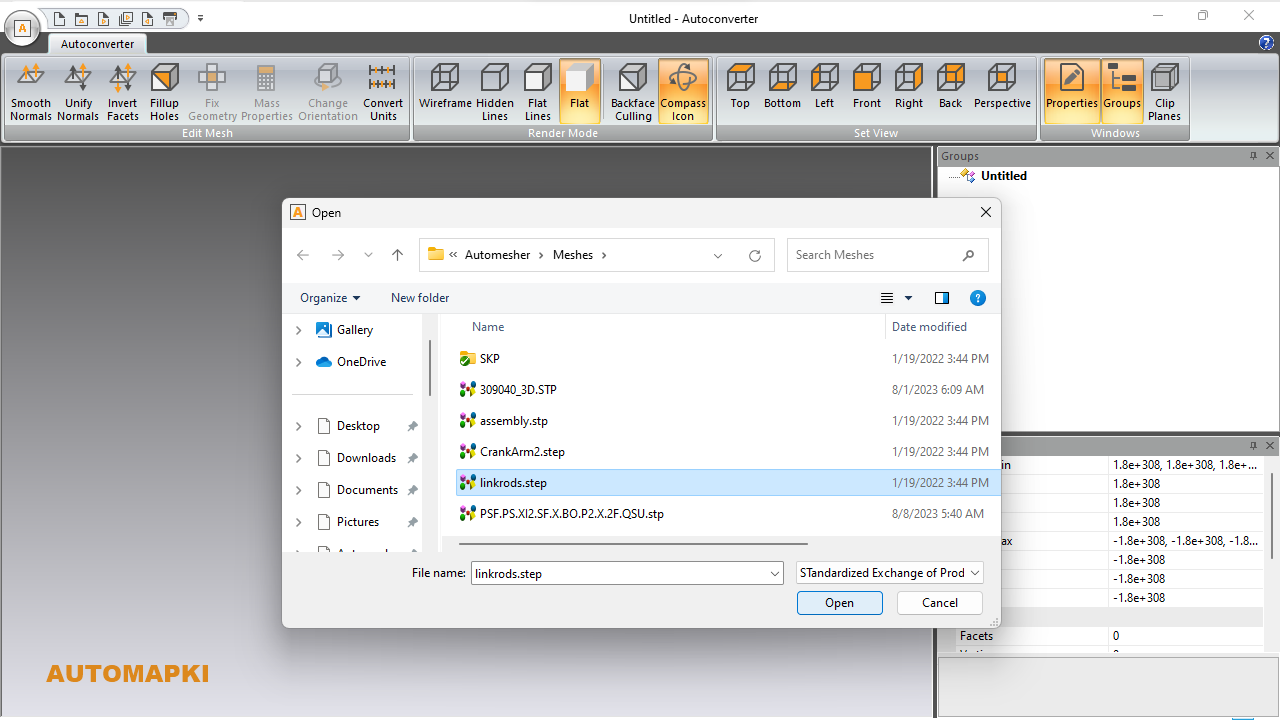
Click Open… and select your .step or .stp file, or drag and drop it into the application window. The model loads into the 3D viewport. Both AP203 and AP214 STEP versions are supported automatically.
📤 Export to SketchUp SKP
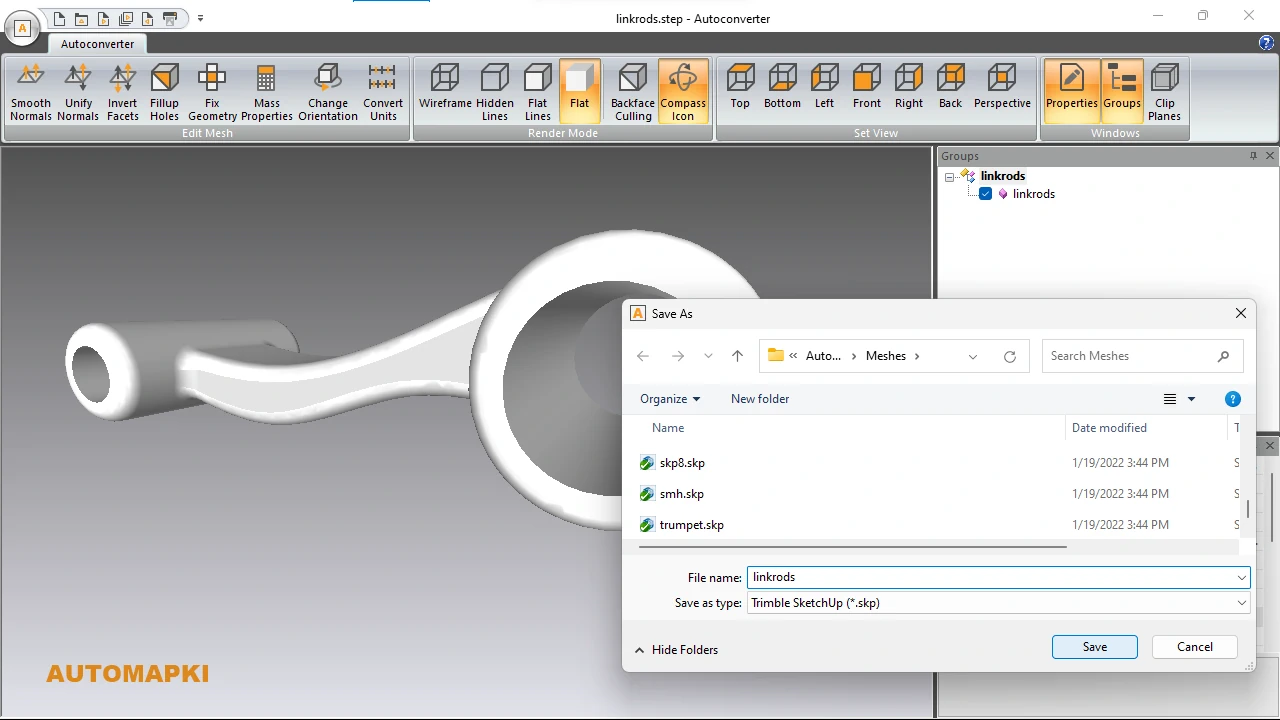
Click Save As… and select SketchUp (*.skp) from the format dropdown. Choose the target SKP version to match the SketchUp installation where the file will be used. Click Save. The STEP NURBS geometry is tessellated and saved as a SketchUp polygon mesh model.
💾 Export to OBJ
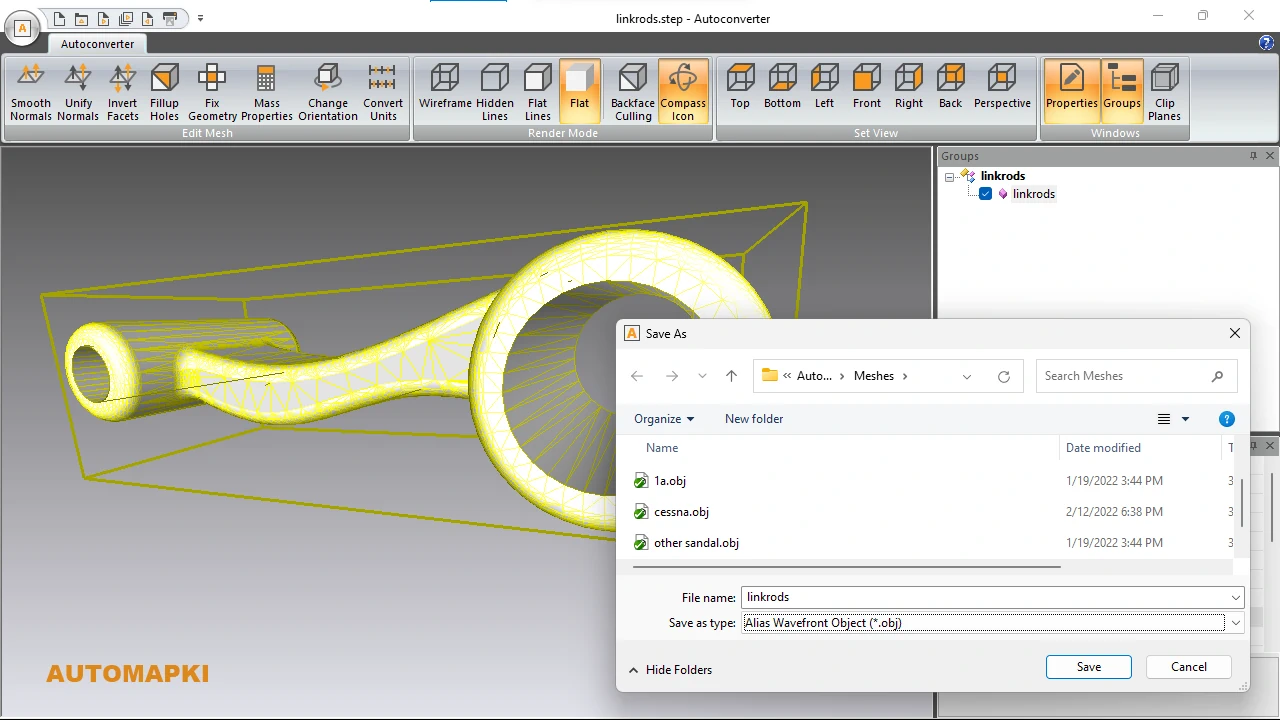
From the same open STEP file, click Save As… again and select Alias Wavefront (*.obj). Autoconverter writes the OBJ file alongside an MTL material file. Keep both in the same folder when importing into Blender or Maya for materials to load correctly.
🔄 Export to STL or Other Formats
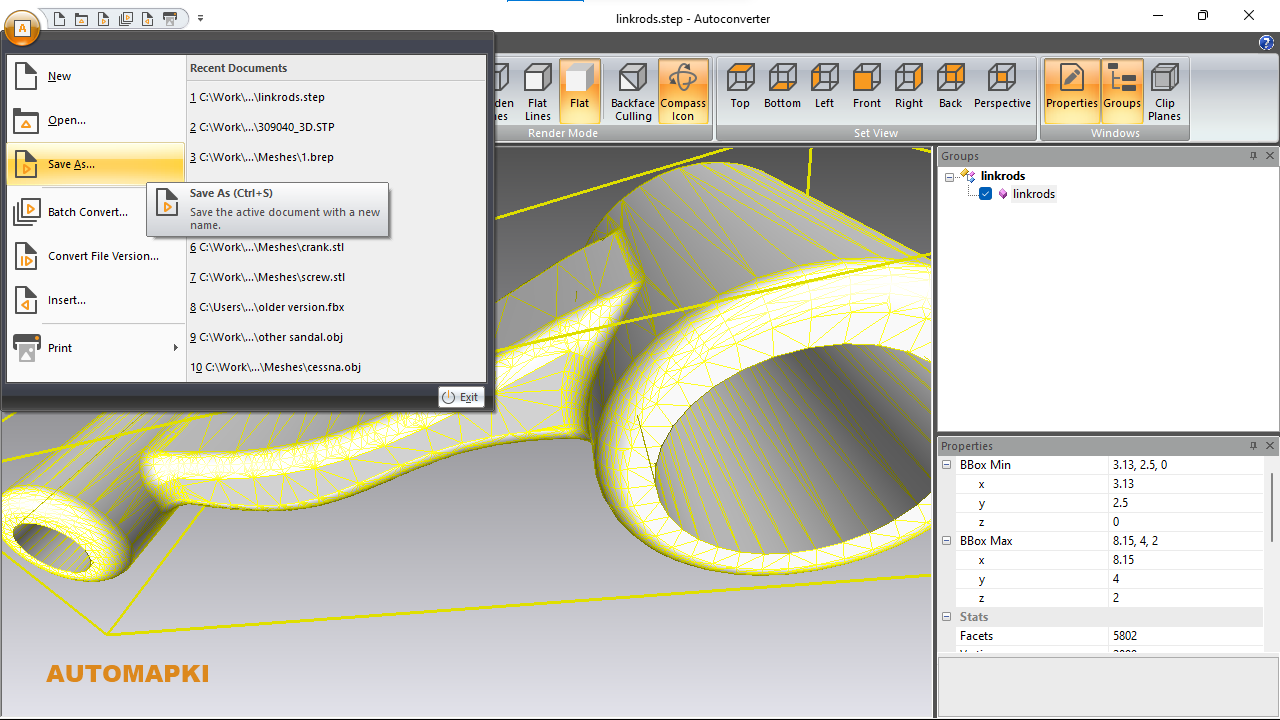
Repeat the Save As step for STL, FBX, 3DM, DAE, or any other required format. Each export runs independently from the same loaded STEP file - you can generate multiple output formats without reopening the source. For STL exports intended for 3D printing, see the STEP to STL guide for detailed tessellation quality settings.
Common STEP to Mesh Use Cases
- STEP to SketchUp - bring SolidWorks, CATIA, or Inventor mechanical models into SketchUp for architectural context, client presentation, or design visualization
- STEP to 3D printing - convert engineering CAD geometry to STL for FDM, resin, or SLS printing without exporting from the original CAD software
- STEP to Blender - import product or mechanical geometry from engineering CAD into Blender for photorealistic rendering or animation
- STEP to game engine - convert industrial or product models to FBX for use in Unity or Unreal Engine product configurators or interactive visualizations
- STEP to Rhino - open STEP geometry in Rhino as a 3DM mesh for further surface modeling and fabrication workflows
- STEP to AutoCAD solid - convert STEP to SAT for import via the ACISIN command as a 3D solid in standard AutoCAD
Frequently Asked Questions
-
Can I convert STEP to multiple mesh formats from the same file?
Yes. Load the STEP file once in Autoconverter and run Save As… as many times as needed, selecting a different format each time. The source geometry stays loaded between exports.
-
Does converting STEP to mesh lose geometric accuracy?
Yes - NURBS-to-mesh conversion (tessellation) approximates smooth curves as flat polygon faces. For visualization and 3D printing, this is acceptable. For precision engineering workflows, keep the STEP file or export to SAT, which preserves solid body geometry for AutoCAD, BricsCAD, and SolidWorks import.
-
What STEP versions and AP standards are supported?
Autoconverter supports AP203, AP214, and AP242 - the full range produced by all major CAD systems including SolidWorks, CATIA, Creo, NX, Inventor, and FreeCAD. Both .step and .stp file extensions open identically.
-
Is there a free trial?
Yes. The free evaluation version of Autoconverter supports up to 10 file conversions. The full licensed version provides unlimited conversions and batch processing.
Summary
Autoconverter converts STEP and STP files to SKP, OBJ, STL, FBX, 3DM, DAE, SAT, and other formats in five steps - multiple output formats from the same source file, no CAD software required. NURBS geometry is tessellated during conversion; for precision solid body output, use SAT. All AP203, AP214, and AP242 STEP versions are supported.
👉 Ready to convert? Download Autoconverter and try it free for up to 10 conversions.