SketchUp models are polygon meshes - every curved surface in a SKP file is actually a series of flat triangular or quadrilateral faces approximating a curve. This is fine for architectural visualization and presentation, but it creates a specific problem when you need to bring SketchUp geometry into a parametric CAD tool: SolidWorks, CATIA, Fusion 360, and Rhino all expect smooth NURBS surfaces or BREP solids, not polygon approximations. You cannot assign a draft angle to a polygon face, run a CFD simulation on a faceted mesh, or generate a smooth CNC toolpath from an SKP import.
Autoshaper bridges this gap by reading the SKP mesh geometry and fitting NURBS patches to it - reconstructing smooth, mathematically defined surfaces that CAD tools recognize as native, editable geometry. The output can be exported to STEP, IGES, or Rhino 3DM, making SketchUp models usable in any professional CAD, CAM, or simulation workflow.
Why SKP Geometry Needs Reconstruction Before CAD Import
SketchUp stores all geometry as planar faces connected at edges. There are no curved surface entities in the SKP format - arcs and circles are stored as sequences of short line segments, and curved faces are stored as grids of flat triangles. When you export an SKP file directly to STEP (as a faceted BREP), the receiving CAD tool sees thousands of tiny flat faces where there should be one smooth cylindrical or spherical surface.
The consequences in CAD workflows are concrete:
- Boolean operations produce jagged intersection curves where a faceted imported body meets a smooth CAD-native solid.
- FEA mesh generation is degraded - the simulation mesher generates poor-quality elements at the boundaries between flat facets, which introduces stress concentration artifacts at what should be smooth transitions.
- CNC toolpaths follow the faceted surface rather than the intended smooth geometry, producing machined parts with visible scalloping at curved features.
- NURBS surface modeling operations fail - you cannot blend, extend, or trim a faceted imported body the way you can a NURBS surface.
NURBS reconstruction with Autoshaper solves all of these by converting the faceted approximation back into smooth parametric surfaces before the geometry enters the CAD tool.
Convert SKP to NURBS with Autoshaper: Step-by-Step
-
📥 Download and Install Autoshaper
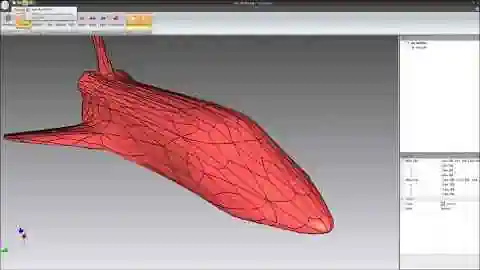
The free trial of Autoshaper is the complete application - no feature restrictions.
-
🚀 Open Autoshaper
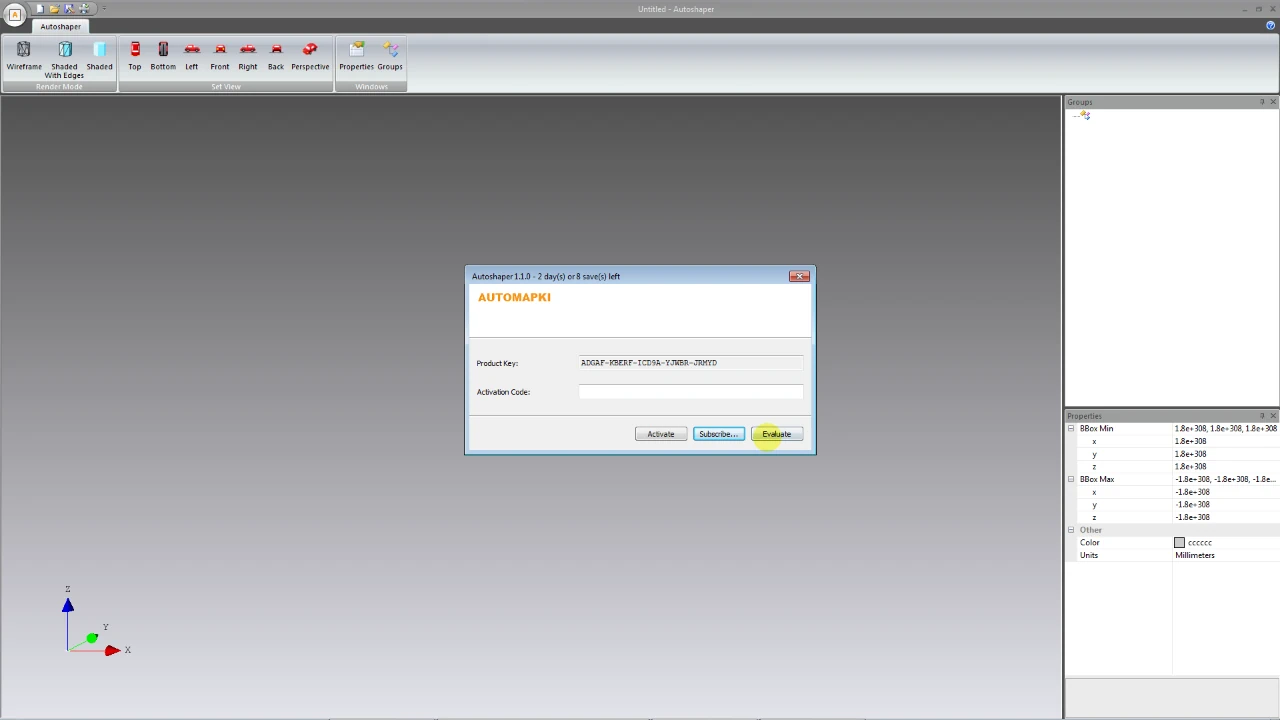
Run Autoshaper from the Windows Start menu.
-
📂 Load your SKP File
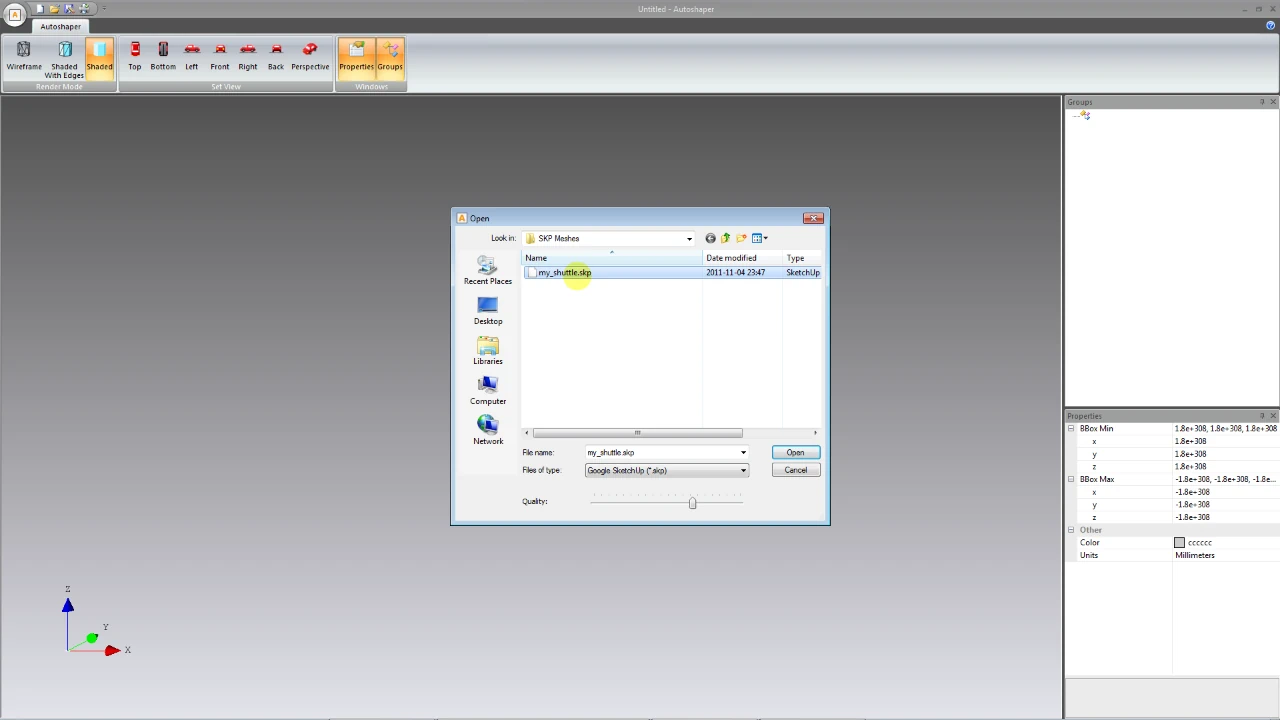
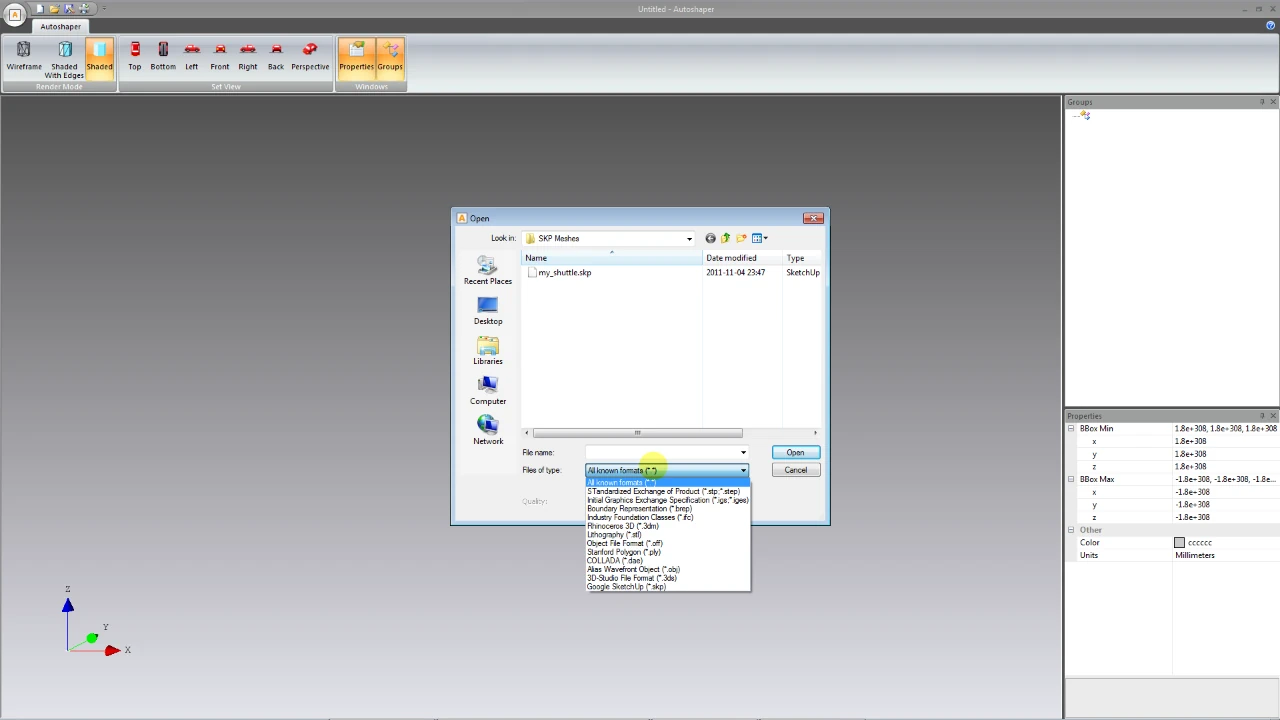
Click Open… and select the SKP file. Autoshaper reads the SKP mesh geometry directly - no intermediate export from SketchUp is needed.
-
🎛 Set the NURBS Patch Density
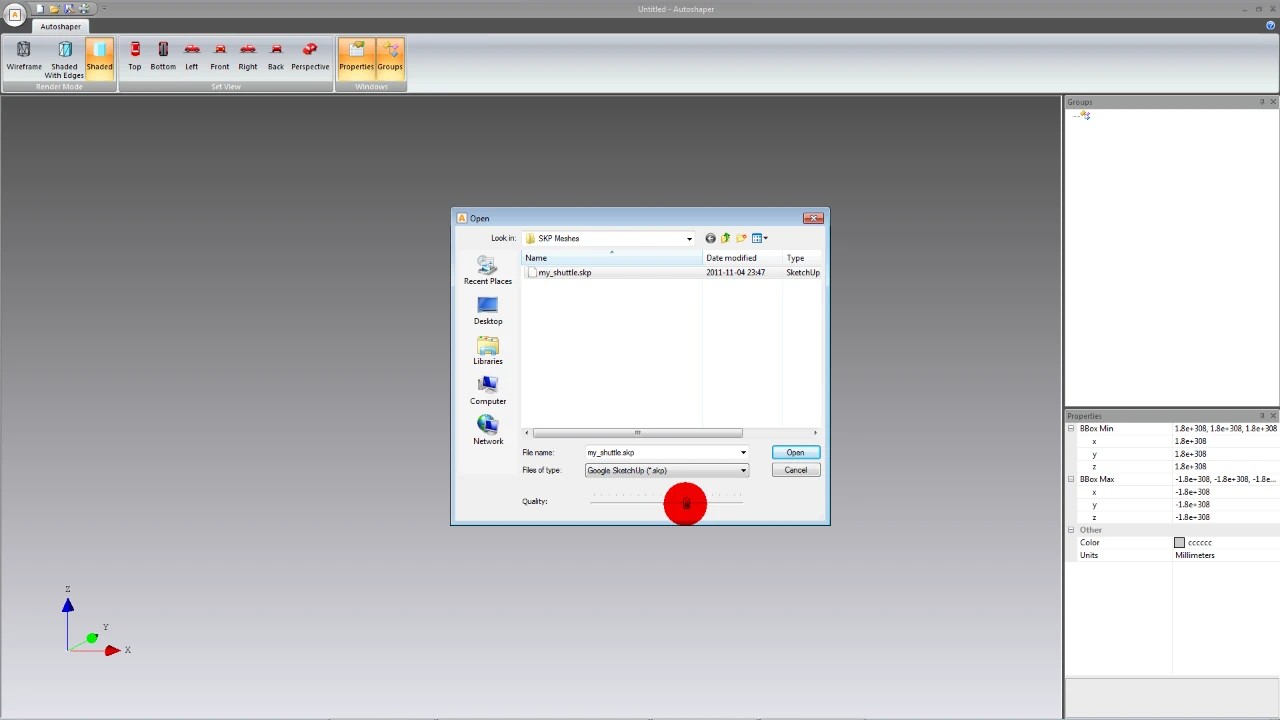
The surface quality slider controls how many NURBS patches are used to cover the model. Higher density fits the input mesh more closely but produces more patches and a larger output file. For a first pass, use the default (medium) setting. For architectural models with large flat faces and simple curves, low-to-medium density is usually sufficient. For organic product shapes or complex freeform geometry, increase to high density.
-
🔄 Run Reconstruction
Click Open to start NURBS fitting. Autoshaper segments the mesh into surface regions and fits a NURBS patch to each region. Processing time depends on model complexity and patch density - most architectural SKP models complete in under two minutes.
-
📐 Review the Reconstructed Surface
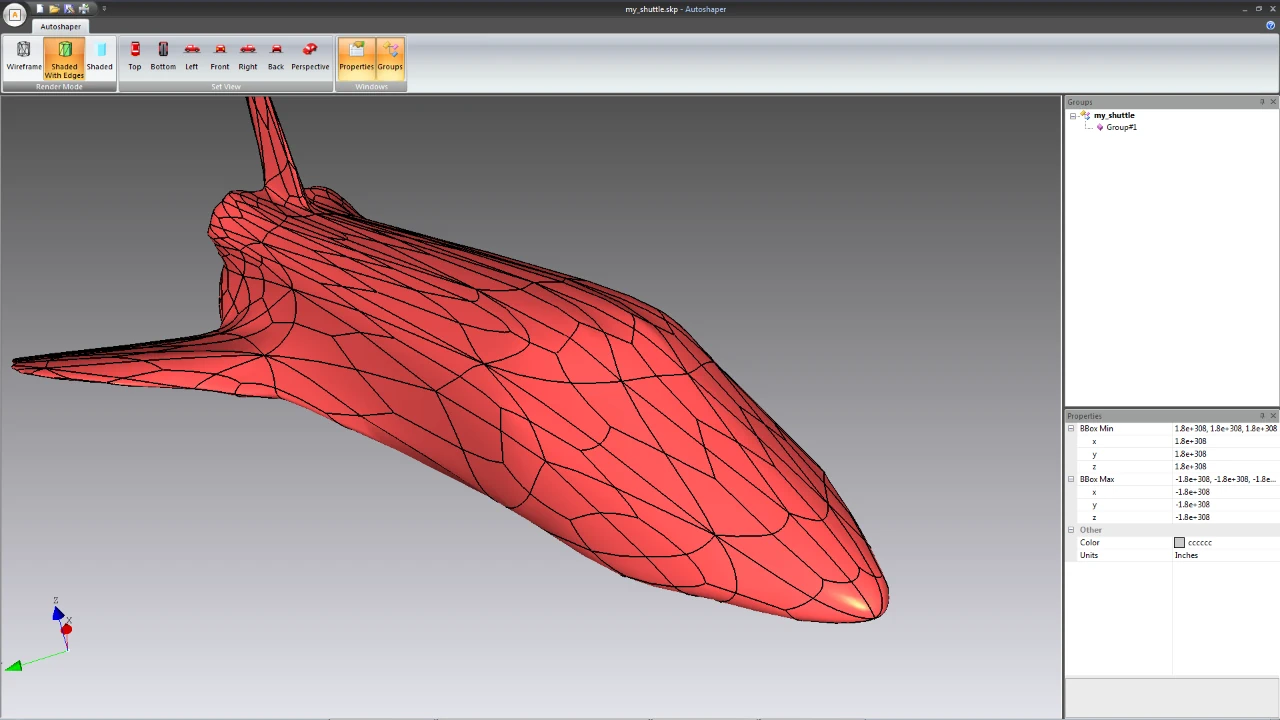
Inspect curved features, transitions between faces, and any formerly reversed-face areas. NURBS patch boundaries should align cleanly with visible feature edges. If patch seams appear in the middle of what should be a smooth surface, the patch density was too low - cancel and re-run at higher density.
Common Use Cases
- SketchUp architectural model to STEP for structural analysis: An architect delivers a SketchUp massing model to a structural engineer who needs to run FEA on the building frame. Autoshaper reconstructs the SKP mesh as NURBS STEP, which the engineer imports into ANSYS where the simulation mesher generates clean elements from smooth surfaces.
- SketchUp product concept to STEP for SolidWorks detailing: A product designer sketches a consumer product form in SketchUp and hands it to a mechanical engineer for detailed CAD work. Autoshaper converts the SKP to NURBS STEP, which SolidWorks imports as a surface body the engineer can use as a reference for parametric feature modeling.
- SKP heritage model to IGES for CNC carving: A conservation team has a SketchUp model of an architectural ornament. Autoshaper reconstructs the curved surfaces as NURBS IGES, which the CAM tool uses to generate smooth 5-axis toolpaths for CNC carving the replacement piece.
- SketchUp landscape model to 3DM for Rhino detailing: A landscape architect models terrain and planting in SketchUp, then needs to add NURBS-modeled furniture and water features in Rhino. Autoshaper converts the SKP to 3DM with editable NURBS surfaces, which Rhino opens natively for continued work.
- SKP urban model to STEP for CFD wind analysis: An urban planning team uses SketchUp to model a city block for wind environment assessment. Autoshaper reconstructs building surfaces as NURBS STEP for import into the CFD pre-processor, where smooth surface geometry improves boundary layer mesh quality.
- SketchUp furniture model to STEP for procurement: A furniture designer needs to share a SketchUp chair model with a manufacturer who requires STEP. Autoshaper converts the SKP to NURBS STEP, giving the manufacturer a solid body they can dimension, tolerance, and use for CNC production without redrawing from scratch.
Frequently Asked Questions
Why does my reconstructed STEP from SKP import as a surface body in SolidWorks instead of a solid?
A surface body result means the NURBS patches do not form a fully closed shell - there are gaps at patch boundaries where the source SKP mesh had open edges or reversed faces. Check the original SKP for open geometry (Window > Model Info > Statistics > Fix Problems in SketchUp), fix any open edges, and re-run the reconstruction. In SolidWorks you can also attempt Insert > Surface > Knit with "Try to form solid" to close small residual gaps after import.
SketchUp curved surfaces are modeled as faceted polygons. How accurately does Autoshaper recover the intended smooth curve?
Accuracy depends on the original facet count. A cylinder modeled with 24 sides in SketchUp will be reconstructed more accurately than one modeled with 12 sides, because Autoshaper has more data points to fit the NURBS patch against. For critical dimensions, increase the segment count of arcs and circles in SketchUp before export. The NURBS fit is a least-squares approximation - it finds the smoothest curve that passes near all the input vertices, so it will always slightly deviate from the original polygon edges.
Can I reconstruct only part of a large SKP model - for example, just one component?
The most reliable approach is to isolate the component in SketchUp, export it as a separate SKP file (right-click the component > Save As), and process only that file in Autoshaper. Processing a smaller, isolated component is faster, easier to inspect, and produces cleaner reconstruction results than processing a full complex model.
The reconstructed NURBS surface looks smooth in Autoshaper's viewport but shows seams when imported into Rhino. Why?
NURBS patch boundaries are C0 continuous by default - they share edge positions but not necessarily tangent directions. This produces a visible crease at patch boundaries under certain lighting. In Rhino, run MatchSrf on adjacent patches to achieve tangency continuity (G1) at shared edges. Alternatively, increase the NURBS patch density in Autoshaper to reduce the number of patch boundaries and place them at natural feature edges where a crease is geometrically expected.
Is there a free trial of Autoshaper?
Yes. Download the free trial of Autoshaper to test SKP-to-NURBS reconstruction with your own SketchUp files before purchasing.
Summary
SketchUp's polygon mesh geometry cannot be used directly in parametric CAD tools for Boolean operations, FEA meshing, or smooth CNC toolpath generation. Autoshaper solves this by reading SKP files directly, segmenting the mesh geometry into surface regions, and fitting NURBS patches using least-squares approximation. The output exports to STEP for SolidWorks, CATIA, and Fusion 360; IGES for legacy aerospace tools; and Rhino 3DM for continued surface editing with full control-point access. Preparing the SKP model with correct face normals and adequate curve segment counts before reconstruction significantly improves output quality.
👉 Ready to convert? Download Autoshaper and try it free.