GLTF 1.0 and GLTF 2.0 are not compatible. A GLTF 1.0 file will not load in Three.js, Babylon.js, Unity, Unreal Engine, or any modern GLTF 2.0 viewer - these tools dropped GLTF 1.0 support when the spec was superseded. If you have GLTF assets from older tools or pipelines that pre-date the 2017 GLTF 2.0 release, you need to convert them before they will work in current rendering environments.
Autoconverter converts GLTF files between versions through its Convert File Version function. Upgrading to GLTF 2.0 also unlocks the option to add Draco mesh compression, which reduces geometry data size by 70–80% - the most impactful optimization for web-delivered 3D assets.
GLTF 1.0 vs GLTF 2.0: What Changed
GLTF 2.0, published in 2017, was a significant revision that broke backward compatibility with GLTF 1.0 in exchange for major improvements:
| Feature | GLTF 1.0 | GLTF 2.0 |
|---|---|---|
| Material model | Arbitrary shaders (GLSL) | PBR metallic-roughness (standardized across renderers) |
| Texture format | External references only | External + base64 embedded + KTX2 compressed textures |
| Geometry compression | Not available | Draco compression via KHR_draco_mesh_compression extension |
| Animation | Basic transform animation | Morph targets, skeletal animation, spline interpolation |
| Extensions | Limited | Rich extension ecosystem (KHR_materials_*, EXT_*, MSFT_*) |
| Tool support | Legacy - most tools removed 1.0 support post-2018 | Universal - all current web engines, game engines, and DCC tools |
The material model change is the most significant: GLTF 1.0 materials reference GLSL shader programs, which are renderer-specific. GLTF 2.0 uses the standardized PBR metallic-roughness workflow that every compliant renderer interprets identically - ensuring consistent appearance across Three.js, Babylon.js, Unity, Unreal, and Apple's SceneKit.
Why Draco Compression Matters for Web GLTF
Draco (developed by Google) is a geometry compression algorithm for polygon mesh data. When applied to GLTF/GLB output, it compresses vertex positions, normals, UV coordinates, and other attributes using quantization and entropy coding. Typical results:
- Geometry data compressed 70–80% compared to uncompressed GLTF binary buffers
- A 10MB GLB with Draco becomes approximately 2–3MB
- Significantly faster initial load time for web 3D viewers and AR experiences
- Supported by Three.js (DRACOLoader), Babylon.js (draco decoder), and all modern GLTF 2.0 runtimes
Draco compression is only available in GLTF 2.0 - the KHR_draco_mesh_compression extension was introduced with GLTF 2.0. It is not available for GLTF 1.0.
How to Convert GLTF Version Using Autoconverter
-
Download and Install Autoconverter
Download and install Autoconverter on Windows and launch it from the Start menu.
-
Open the GLTF Version Converter
Go to File > Convert File Version… - this opens the GLTF version conversion dialog without loading the full model into the 3D viewport. This is the correct path for version-only conversion.
-
Select the Source GLTF or GLB File
In the file browser, select your source GLTF or GLB file and specify the output filename and location. Use a .glb extension for single binary output; use .gltf for multi-file JSON output.
-
Choose the Target GLTF Version
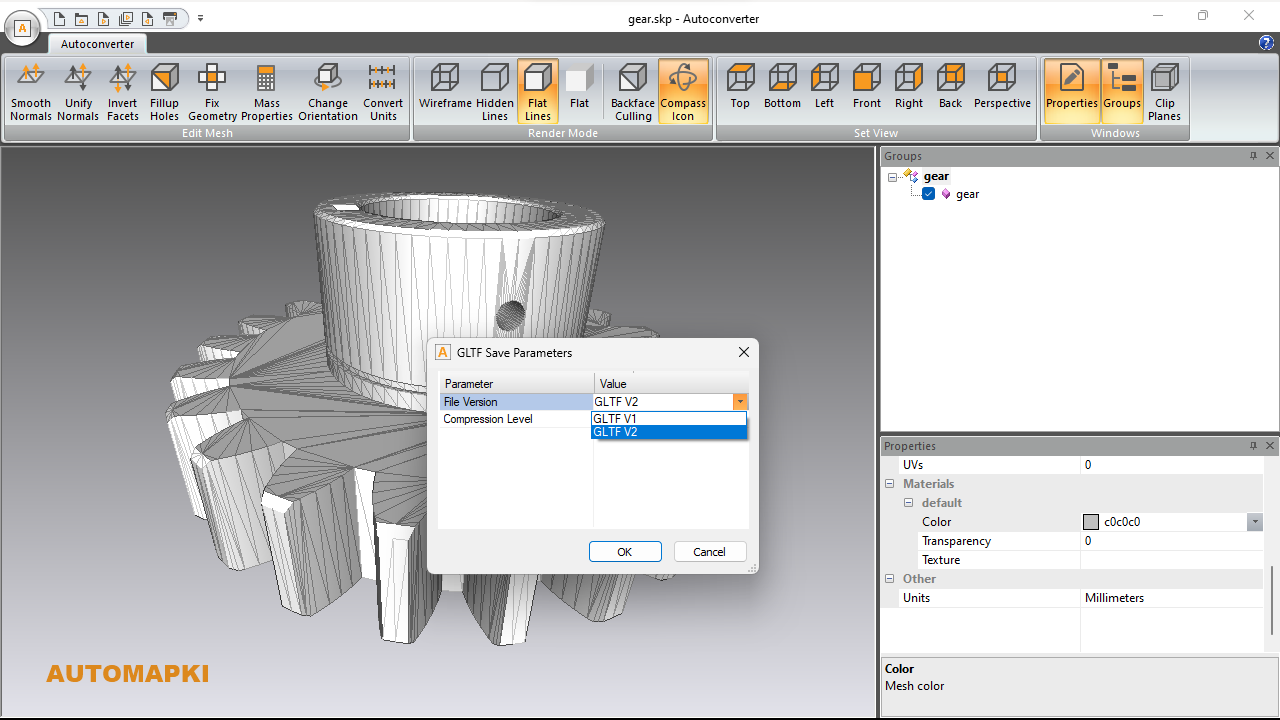
In the GLTF Save Parameters dialog, select the target version - GLTF V1 or GLTF V2.
-
Enable Draco Compression (Optional)
If converting to GLTF V2, enable Draco Compression to apply the
KHR_draco_mesh_compressionextension to the output geometry. This is optional but strongly recommended for web deployment. -
Save the Converted File
Click OK. Autoconverter writes the output file in the target version.
When to Convert GLTF 2.0 Back to GLTF 1.0
Converting from GLTF 2.0 to GLTF 1.0 is rarely needed but occasionally required for legacy toolchains that were built against the GLTF 1.0 spec and never updated. Specific cases include older proprietary enterprise visualization tools, certain game engines from the 2015–2017 period, and legacy WebGL applications with custom GLTF 1.0 loaders that were never migrated to GLTF 2.0.
When downgrading, the PBR metallic-roughness materials from GLTF 2.0 are converted to GLTF 1.0 material representations. Some material properties specific to GLTF 2.0 PBR may not have direct equivalents and will be approximated.
Command Line GLTF Version Conversion
For automated pipelines, GLTF version conversion is available from the Autoconverter command line:
; Convert GLTF 1.0 to GLTF 2.0 (no Draco)
Autoconverter.exe -in "model_v1.gltf" -out "model_v2.glb" -file_version "GLTF 2.0"

; Convert to GLTF 2.0 with Draco compression
Autoconverter.exe -in "model_v1.gltf" -out "model_v2_draco.glb" -file_version "GLTF 2.0" -compression Maximum
Frequently Asked Questions
Why won't my GLTF file load in Three.js or Babylon.js?
Three.js, Babylon.js, and all current GLTF runtimes support GLTF 2.0 only - GLTF 1.0 support was removed from these libraries in 2018–2019. Convert your GLTF 1.0 file to GLTF 2.0 using Autoconverter's Convert File Version function to restore compatibility.
Does adding Draco compression affect visual quality?
Draco uses quantization - vertex coordinates are rounded to a finite number of bits (default is typically 14 bits for position, 10 for normals). For most web 3D assets this is imperceptible; for engineering or medical models requiring submillimeter precision, test the output against accuracy requirements. The quantization level is configurable.
Should I use .gltf or .glb output when converting?
Use .glb (binary GLB) for almost all deployment cases - it bundles geometry, materials, and textures in a single self-contained file. Use .gltf only when you specifically need human-readable JSON for debugging or manual editing of the scene structure. See the GLTF vs GLB comparison guide for a full explanation.
Is there a free trial?
Yes. The free evaluation version of Autoconverter supports up to 10 file conversions including GLTF version conversion. The full licensed version provides unlimited conversions.
Summary
GLTF 1.0 and GLTF 2.0 are incompatible - GLTF 1.0 files will not load in any current {category_link GLTF{ runtime. Autoconverter's Convert File Version function upgrades GLTF 1.0 to GLTF 2.0, migrating materials from GLSL shaders to PBR metallic-roughness. Enabling Draco compression during conversion reduces geometry data by 70–80% for faster web loading. The CLI -compression Ultra parameter enables batch conversion to Draco-compressed GLTF 2.0.
👉 Ready to convert? Download Autoconverter and try it free for up to 10 conversions.