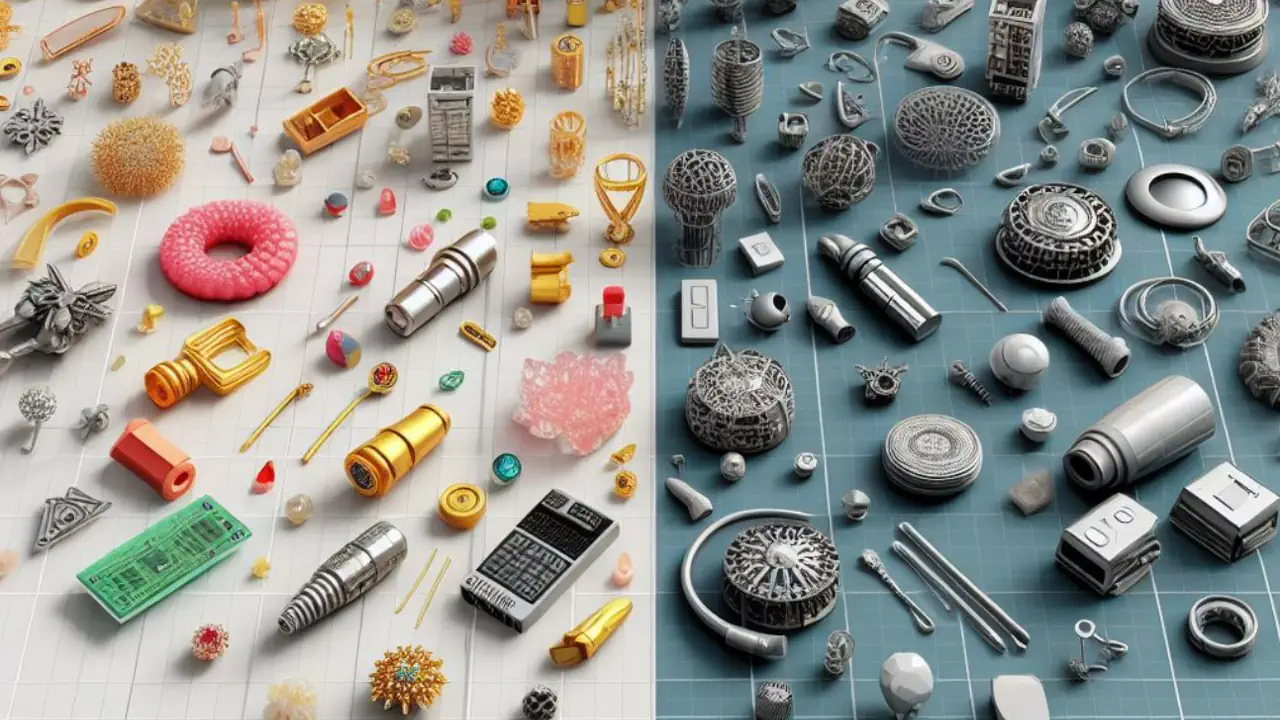
SketchUp is a widely used tool for architectural design, product visualization, and engineering. But if you work with components measured in micrometers - MEMS devices, microfluidic channels, semiconductor packages, or precision optical parts - you'll hit a hard wall: SketchUp silently drops or corrupts any geometry smaller than its internal precision floor. The frustrating part is that the software gives no clear error message; faces simply disappear, edges collapse, or the model imports as empty geometry.
Autoconverter solves this by applying a scale multiplier during conversion, so your micrometer-dimension source file is written into the SKP format at a size SketchUp can actually store - without you having to manually rebuild the model at a different scale.
Why SketchUp Cannot Store Micrometer Geometry
The SKP file format stores all coordinates in inches internally. Its minimum resolvable edge length is 0.001 inches, which equals approximately 0.0254 mm or 25.4 µm. Any edge shorter than this threshold is considered degenerate and is either merged to a point or omitted entirely during file write.
This is not a display setting or a units preference - it is a fixed property of the SKP binary format itself. Changing the display units in SketchUp's Model Info from inches to millimeters does not change the underlying precision; it only changes how coordinates are labeled in the UI. A 10 µm cube has edges of 0.0004 inches, which is 40× below the minimum threshold. SketchUp will not store it.
| Geometry size | SKP storable? | Notes |
|---|---|---|
| 1 mm | ✅ Yes | Well above 0.001 in threshold |
| 0.1 mm (100 µm) | ✅ Yes | Marginal; some edges may merge |
| 0.025 mm (25 µm) | ⚠️ Borderline | Right at the limit; results vary |
| 0.01 mm (10 µm) | ❌ No | Edges collapse; faces disappear |
| 0.001 mm (1 µm) | ❌ No | Entire model imports as empty |
| 1 nm (nanometer) | ❌ No | Far outside any workable range |
How Autoconverter Handles the Scale Problem
Autoconverter reads your source file in its native units, then applies a scale multiplier before writing the SKP output. For a model authored in micrometers, a scale factor of 1000 converts every coordinate from µm to mm - lifting a 10 µm edge to 10 mm (0.394 inches), well above SKP's storage threshold. The resulting SKP file is dimensionally correct at the millimeter scale; you simply work in SketchUp knowing that 1 unit represents 1 µm in the real object.
This is the same logical approach as the manual "scale up, then scale down" workaround used inside SketchUp, but Autoconverter does it in a single automated conversion step and supports all major source formats - no manual rebuilding required.
Manual Workaround Inside SketchUp (Without Autoconverter)
If you need to author a micro-scale model directly in SketchUp without an external converter, the standard workaround is to model at a scaled-up size, group the geometry, then record the scale factor in your documentation:
- Decide on a scale factor. For micrometer work, 1 mm per 1 µm (factor of 1000) is typical.
- Create your geometry using millimeter dimensions. A 10 µm feature becomes a 10 mm feature in the model.
- Select all geometry and group it (Edit > Make Group).
- Apply a 0.001 scale multiplier for the group.
Supported Source Formats for Micro-Scale Conversion
- STEP / STP - STEP stores exact NURBS; Autoconverter tessellates to mesh before SKP write
- STL - No unit metadata in STL - you must know the authoring unit to set scale correctly
- OBJ - OBJ has no embedded unit; same manual unit identification required
- 3MF - 3MF stores units explicitly (millimeters by default); Autoconverter reads them automatically
- FBX - FBX embeds a unit scale factor; Autoconverter reads it, then applies the additional SKP scale
- BLEND - Blender supports custom unit scales; verify the scene unit before converting
Frequently Asked Questions
SketchUp shows the model but faces are missing. What went wrong?
Partial face loss happens when some edges are above the precision threshold but others are not. Edges just at the limit (0.001–0.003 inches) survive as lines but SketchUp cannot close a face from them.
Does STL carry unit information?
No. The STL specification does not include any unit metadata. Autoconverter cannot infer whether an STL was authored in meters, millimeters, inches, or micrometers. 3MF and FBX both embed unit information and are handled automatically.
Is there a free trial of Autoconverter?
Yes. A free trial of Autoconverter is available to download and evaluate. The full licensed version provides unlimited conversions and batch processing.
Summary
SketchUp's SKP format has a hard precision floor of 0.001 inches (~25 µm). Any geometry smaller than this is silently dropped during file write, which means micro-scale models - MEMS, microfluidics, precision optics - cannot be stored in SKP without a scale workaround. Autoconverter solves this with a scale multiplier applied during conversion: a 1000× factor lifts micrometer-dimension geometry to millimeter size, safely above SKP's threshold, while preserving all faces and edges.
👉 Ready to convert? Download Autoconverter and try it free for up to 10 conversions.